Engine airflow is one of the most fundamental factors affecting performance, efficiency, and emissions. Simply put, an engine must receive the correct amount of clean air to operate smoothly. When airflow becomes restricted, unmeasured, or inconsistent, drivability issues often follow.
This guide explains engine airflow basics, how air moves through the engine, and why even small disruptions can have noticeable effects.
Why Airflow Matters in an Engine
Every combustion cycle relies on a precise balance of air and fuel. Therefore, airflow accuracy directly influences power output, fuel economy, and emissions control. When airflow is properly regulated, the engine can respond predictably under all driving conditions.
However, if airflow is reduced or miscalculated, the engine may struggle to maintain that balance.
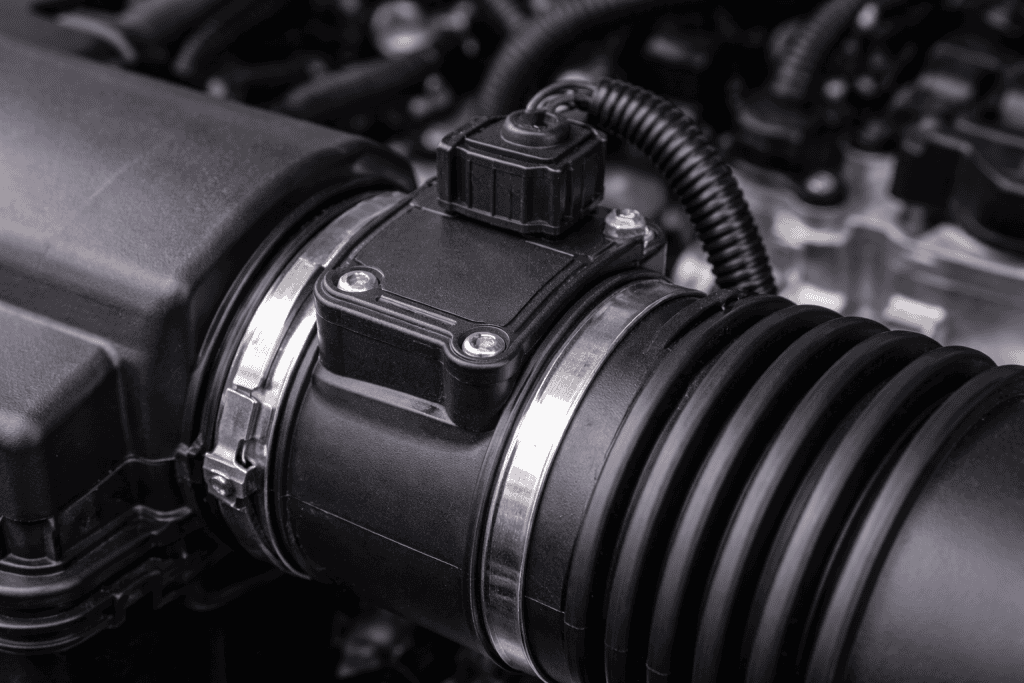
Close-up view of a Mass Air Flow (MAF) sensor installed in the intake tube, showing the sensor housing and electrical connector.
How Air Enters the Engine
Air enters the engine through a defined path designed to measure, filter, and control flow:
Air intake opening draws in outside air
Engine air filter removes dust and debris
Mass Air Flow (MAF) or MAP sensor measures airflow
Throttle body regulates air volume
Intake manifold distributes air to each cylinder
Each component must function correctly, because a problem anywhere in the system can affect overall performance.
The Role of the Throttle Body
The throttle body controls how much air enters the engine based on accelerator input. At idle, airflow is minimal and tightly controlled. During acceleration, airflow increases rapidly.
Over time, however, carbon buildup can restrict airflow around the throttle plate. As a result, idle quality and throttle response may suffer.
Mass Air Flow (MAF) sensors, which directly measure air volume
Manifold Absolute Pressure (MAP) sensors, which calculate airflow indirectly
Accurate sensor data allows the engine control unit to adjust fuel delivery accordingly. If that data becomes unreliable, fuel mixture problems can occur.
Common Symptoms of Airflow Problems
When airflow is restricted or misread, several symptoms may appear, including:
Rough or unstable idle
Hesitation during acceleration
Reduced engine power
Poor fuel efficiency
Inconsistent throttle response
Although these symptoms can overlap with other issues, airflow problems are among the most common causes.
How Airflow Affects Emissions and Efficiency
Because airflow directly impacts combustion quality, it also affects emissions output. Inconsistent airflow can lead to incomplete combustion, increasing emissions and reducing efficiency.
For that reason, maintaining proper airflow supports not only performance, but also long-term engine health.
Why Airflow Issues Often Develop Gradually
Unlike sudden mechanical failures, airflow-related problems typically develop over time. Dirt accumulation, sensor contamination, and minor vacuum leaks often worsen slowly. Consequently, drivers may adapt to declining performance without realizing the cause.
Regular inspection and basic maintenance help prevent these issues from escalating.
Engine airflow plays a critical role in how smoothly and efficiently a vehicle operates. By understanding how air enters, is measured, and is controlled, drivers can better recognize early warning signs and maintain consistent performance over time.
This platform analyzes depreciation trends, resale value behavior, and long-term ownership costs, helping drivers understand how mileage, maintenance, and timing shape real financial outcomes.