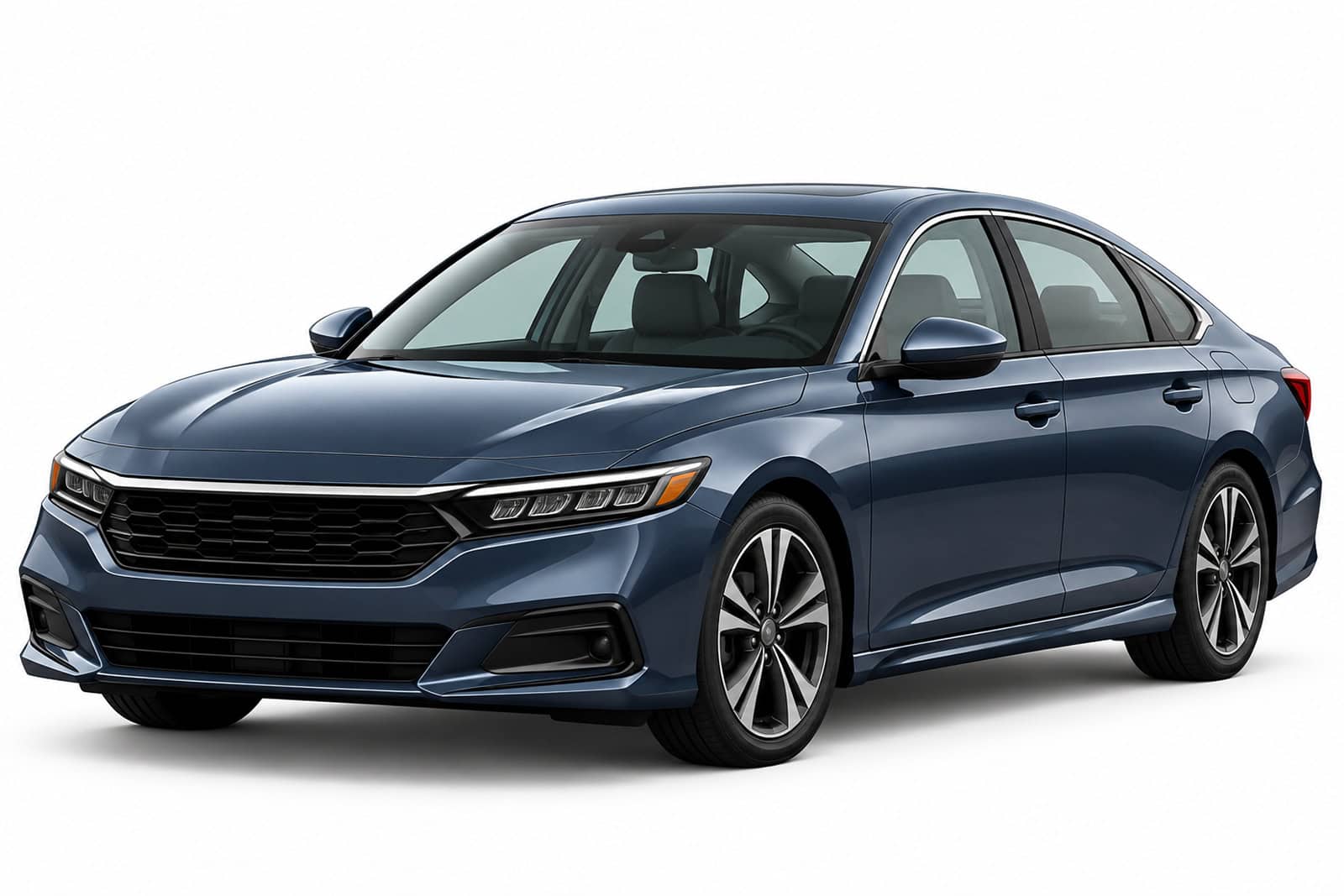
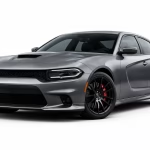
The Honda Accord has been part of the North American car market since 1976. What began as a compact hatchback eventually grew into the midsize sedan you know today. Eleven generations have brought larger cabins, stronger engines, better crash protection, modern driver assistance, and increasingly efficient powertrains. The Accord has also moved with the market. V6 engines and coupes disappeared. Turbocharged four-cylinder engines arrived. Hybrid power now plays a much larger role in the lineup. If you are shopping for an Accord in the U.S. or Canada, you have a wide range of new and used models to consider. Recent versions seat 5 people, use front-wheel drive, and offer gasoline or hybrid power depending on the model year and trim. Older generations give you more engine and body-style choices. The important part is understanding which Accord fits your driving, budget, and ownership plans. This overview covers those differences without assuming that every Accord built since 1976 is the same car.
Where the Honda Accord Fits in the Market
The Accord competes in the midsize sedan class. Its familiar rivals include the Toyota Camry, Hyundai Sonata, Kia K5, and Nissan Altima. That puts it in a category built around everyday transportation rather than the higher price and running costs of a luxury sedan. You get 5-passenger seating, a separate trunk, front-wheel drive, and enough interior space to handle commuting or family use. The Accord’s long production history also gives used-car shoppers choices ranging from inexpensive older models to recent hybrids.
- Vehicle class: Midsize sedan on recent generations.
- Main competitors: Toyota Camry, Hyundai Sonata, Kia K5, and Nissan Altima.
- Seating: Up to 5 occupants in current models.
- Drivetrain: Front-wheel drive on current U.S. and Canadian Accords.
- Power choices: Gasoline and hybrid choices vary by model year and trim.
- Main ownership strengths: Fuel economy, passenger room, resale value, and a long history in the North American market.
Honda Accord Body Styles and Drivetrain
If you are looking at a current Accord, your choices are much simpler than they were several generations ago. The modern Accord is a 4-door sedan with seating for 5 and front-wheel drive. Honda does not currently give U.S. or Canadian Accord buyers an all-wheel-drive option. That distinction matters if AWD is high on your shopping list. You would need to consider another vehicle rather than assuming it can be added to a higher Accord trim. Used Accords are a different story. Over its long history, Honda sold the nameplate as a hatchback, sedan, coupe, and wagon depending on the generation and market. Some older cars also came with V6 engines and manual transmissions. That variety is one reason you should shop by model year rather than treating “Honda Accord” as one specification. A 2007 V6 coupe and a recent Accord Hybrid may share a name, but the ownership experience, fuel use, performance, and maintenance needs are very different.
Honda Accord Gas Engines
Recent Accord generations have increasingly relied on smaller four-cylinder engines. The 1.5L turbocharged four-cylinder became an important part of the lineup because it provides everyday power without the fuel consumption of the older V6 engines. The previous generation also offered a 2.0L turbocharged four-cylinder with substantially more performance. If you are buying used, that gives you choices that are no longer available in the newest lineup.
- 1.5L turbo: Designed to balance everyday performance with lower fuel consumption.
- 2.0L turbo: Offered on the previous generation as the stronger performance choice.
- Older V6 engines: Available on earlier Accord generations but eventually discontinued.
- Drivetrain: Recent gasoline Accords send power to the front wheels.
- Buying consideration: Engine availability changes significantly by year and trim, so check the exact powertrain before comparing two used Accords.
Honda Accord Hybrid System
The Accord Hybrid combines a gasoline engine with electric motors to reduce fuel consumption. You do not plug it into a charger. The car manages the gasoline and electric portions of the system automatically while you drive. That makes it very different from a fully electric vehicle or a plug-in hybrid. You fill the fuel tank normally and drive it much like a regular Accord. Hybrid power has become increasingly important in the latest Accord lineup. The biggest benefit appears during driving where the system can make frequent use of electric assistance, especially in city traffic. If you cover a lot of kilometres or miles every year, the fuel savings can become meaningful. You should still compare the purchase price with your expected fuel use. Someone driving 6,000 miles a year may reach a different conclusion than someone commuting 20,000 miles annually.
Honda Accord Fuel Economy
Fuel economy changes with the model year, engine, trim, wheel size, and test method, so there is no single mpg or L/100 km figure that represents every Accord. Based on the figures supplied for this overview, recent 1.5L turbo models fall around 30–33 mpg combined in U.S. measurements, while hybrids can reach roughly 44–48 mpg combined. Canadian figures place the 1.5L turbo around 7.1–7.6 L/100 km combined and hybrids around 4.8–5.2 L/100 km. Your real fuel use can change with temperature, speed, traffic, tires, and driving habits.
| Powertrain |
U.S. Combined |
Canada Combined |
| 1.5L Turbo |
~30–33 mpg |
~7.1–7.6 L/100 km |
| Hybrid |
~44–48 mpg |
~4.8–5.2 L/100 km |
Honda Accord Interior and Passenger Space
Passenger room is one of the reasons the Accord works for more than commuting. Recent models seat 5 people and provide useful rear-seat space for adults or growing children. You also get a conventional trunk rather than the open cargo area of an SUV. A wide trunk opening makes loading groceries, luggage, and other everyday cargo easier. If you regularly carry bulky items, however, you should check whether the trunk opening and folding rear seats work for what you actually transport.
Technology has changed considerably between generations. Recent Accords can include touchscreen infotainment, Apple CarPlay, Android Auto, and a digital instrument display. Older used cars may have much simpler systems. That is not automatically a disadvantage if you mainly want dependable transportation. Sit in the car and use the controls before buying. A larger screen sounds impressive on a specification sheet, but controls you can understand without conducting a small research project are worth something too.
Honda Accord Safety and Honda Sensing
Recent Accords use Honda Sensing, Honda’s group of driver assistance features. These systems are designed to help you recognize certain hazards, maintain your position on the road, and reduce the workload of highway driving. They do not make the Accord self-driving. You remain responsible for steering, braking, watching traffic, and responding when road conditions require it. Available equipment can also change by model year, so check the exact car when shopping used.
- Collision Mitigation Braking System: Can warn you of a possible frontal collision and provide braking assistance in certain situations.
- Lane Keeping Assist System: Can provide steering assistance to help keep the Accord within a detected lane.
- Adaptive Cruise Control: Adjusts vehicle speed to help maintain a selected following interval behind detected traffic.
- Road Departure Mitigation: Can warn you and provide assistance when the system detects that the vehicle may leave the roadway.
- Traffic Sign Recognition: Can identify certain road signs and display recognized information to the driver.
Honda Accord Reliability and Long-Term Ownership
The Accord has built much of its reputation around long-term ownership, but the badge alone cannot tell you whether a particular used car will be reliable. Eleven generations mean different engines, transmissions, hybrid systems, and known trouble areas. Maintenance history becomes increasingly important as mileage rises. A properly serviced Accord with 100,000 miles can be a much safer purchase than a lower-mileage car whose previous owner repeatedly skipped maintenance. If reliability is your priority, research the specific year and powertrain before buying. Check maintenance records. Look for accident history and unresolved recalls. Have a used car inspected before money changes hands. You can also check our Honda Accord reliability guide for a deeper look at long-term dependability and the Accord problems guide for issues worth checking before you buy.
Honda Accord Resale Value
Resale value matters because depreciation is usually one of the largest costs of owning a newer vehicle. An Accord with stronger demand in the used market can leave you with more money when you eventually sell or trade it. Age and mileage still have a major effect. Condition, accident history, trim, powertrain, location, maintenance records, and the overall used-car market can move the value in either direction. You should therefore treat resale value as part of the ownership calculation rather than a guarantee. Paying thousands more for a car solely because you expect it to hold its value can cancel out some of that future benefit. Compare the purchase price with expected depreciation and running costs. Our Honda Accord depreciation guide goes deeper into how Accord values change as the vehicle gets older.
Who Should Consider a Honda Accord?
The Accord makes the most sense when you want sedan space without moving into a larger SUV. A commuter may care most about fuel economy. A family may put rear-seat room and safety equipment first. A high-mileage driver may find the hybrid’s lower fuel consumption more valuable. A used-car shopper may instead prioritize a proven service history and a purchase price that leaves room in the budget for future maintenance. Your best match depends on how you will actually use the car.
- Daily commuters: The 1.5L turbo and hybrid choices can keep fuel use reasonable during frequent driving.
- Families: Seating for 5 and a roomy cabin make the Accord useful when you do not need 3 rows.
- High-mileage drivers: Hybrid fuel economy can become more valuable as annual mileage increases.
- Used-car buyers: Eleven generations provide a wide range of ages, engines, equipment levels, and prices.
- Long-term owners: A documented maintenance history can help you avoid buying years of someone else’s neglected service.
- Drivers who do not need AWD: Front-wheel drive keeps the current Accord lineup simple, but buyers who require AWD will need to shop elsewhere.
Honda Accord Advantages
The Accord’s strengths come from how several useful qualities work together rather than one headline specification. You can get room for 5 people, competitive fuel economy, modern safety equipment, and gasoline or hybrid power without entering the luxury-car price category. Used buyers also have decades of model years to choose from. The important part is matching those advantages to the generation you are considering because features and powertrains changed considerably over time.
- Fuel economy: Recent hybrid models can reach roughly 44–48 mpg combined based on the supplied U.S. figures.
- Passenger space: The midsize cabin gives adults useful front and rear seating room.
- Powertrain choice: Depending on year, you can find naturally aspirated, turbocharged, V6, or hybrid Accords.
- Safety equipment: Honda Sensing brings several driver assistance systems together on modern models.
- Used availability: The Accord’s long North American history gives you many model years and price points to compare.
- Resale: Strong used-market demand can help reduce the amount of value you lose during ownership.
Honda Accord Limitations
No car fits every buyer, and the Accord has several limitations worth knowing before you spend money. The most obvious is the lack of AWD on current U.S. and Canadian models. Front-wheel drive can handle winter conditions with suitable tires, but it does not become AWD simply because you select a more expensive trim. Buyers looking at turbocharged or hybrid versions should also understand that the maintenance and repair considerations are different from those of older, simpler Accord powertrains.
- No AWD: Current Accords use front-wheel drive, so AWD shoppers need another model.
- Higher hybrid purchase price: You should compare the extra upfront cost with your annual fuel savings.
- Turbo maintenance: Proper oil and routine maintenance matter if you plan to keep a turbocharged Accord for many years.
- No current V6: Buyers wanting the character and power of an Accord V6 must shop older generations.
- No current coupe: The Accord is now focused on the 4-door sedan body style.
Honda Accord Overview: What You Should Know Before Buying
The Honda Accord gives you considerably more choice when you look beyond the newest model. Older generations include coupes, V6 engines, conventional four-cylinder engines, and other configurations that disappeared as Honda moved toward turbocharged and hybrid power. Recent Accords focus more heavily on fuel economy, driver assistance, connectivity, and hybrid technology. That evolution means the model year matters almost as much as the Accord name itself. Before buying, decide what you actually need from the car. Compare gasoline and hybrid fuel costs if you drive frequently. Check whether front-wheel drive works for your climate and roads. Research the reliability record of the specific year and engine. Then inspect the individual vehicle and its maintenance history. If you are shopping used and want to narrow the choices further, the Honda Accord buyer’s guide covers years, trims, costs, and the details that deserve attention before you buy.