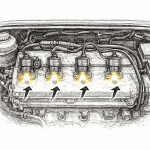
Spark plug replacement overview
You’ll be working on a cool engine, removing ignition components, swapping plugs, then reinstalling everything in the same order.
Preparation and safety
1. Preparation and safety
Cool the engine Let the engine cool completely so the aluminum cylinder head and plugs aren’t hot.
Disconnect the battery
- Action: Remove the negative battery terminal.
- Why: Reduces risk of short circuits while working near ignition components.
Gather tools and parts
- Spark plug socket (usually with rubber insert or magnet)
- Ratchet and extensions
- Torque wrench (recommended)
- New spark plugs (correct type and gap for your engine)
- Dielectric grease (for boots)
- Anti-seize only if manufacturer allows (many modern plugs do not want it)
2. Accessing the spark plugs
- Remove engine cover (if equipped)
- Action: Unscrew or unclip the plastic engine cover to expose ignition coils or plug wires.
- Identify ignition system type
- Coil-on-plug: One small coil sitting directly on each plug.
- Plug wires: Thick rubber wires running from a distributor/coil pack to each plug.
- Work one cylinder at a time
- Action: Finish one plug completely before moving to the next.
- Why: Prevents mixing up wires or coils.
3. Spark Plug Removal With Socket
- Unplug electrical connector (coil-on-plug)
- Remove coil hold-down bolt (if present)
- Action: Use a small socket to remove the bolt, then gently twist and pull the coil straight up.
- Remove plug wire (if equipped)
4. Removing the old spark plug
- Clean around the plug
- Install spark plug socket and extension
- Action: Place the socket straight down onto the plug, feel it seat fully.
- Loosen the plug
- Action: Turn counterclockwise with the ratchet until the plug spins freely.
- Then: Remove the ratchet and spin the extension by hand to fully remove the plug.
- Inspect the old plug (quick check)
5. Preparing the new spark plug
- Check the gap (if required)
- Action: Use a gap tool to verify the gap matches spec.
- Note: Some plugs come pre-gapped; still verify gently without bending the fine wire too much.
- Apply anti-seize only if recommended
- If allowed: Use a tiny amount on the threads, avoiding the tip.
- If not recommended: Install dry as per manufacturer.
- Keep the plug clean
- Action: Don’t touch or drop the electrode; avoid oil/grease on the tip.
6. Installing the new spark plug
- Start threading by hand
- Action: Put the plug into the socket, lower it into the hole, and turn the extension by hand clockwise.
- Goal: It should thread smoothly—no resistance or cross-threading.
- Snug the plug
- Action: Once hand-tight, attach the ratchet and gently snug it.
- Torque the plug
- Action: Use a torque wrench to tighten to the manufacturer’s spec.
- Why: Too loose can leak; too tight can damage threads or the plug.
7. Reinstalling coils or plug wires
- Coil-on-plug
- Action:
- Apply a small dab of dielectric grease inside the coil boot.
- Push the coil straight down onto the plug until fully seated.
- Reinstall the coil bolt and tighten snugly.
- Reconnect the electrical connector.
- Plug wires
- Action:
- Apply a small dab of dielectric grease inside the boot.
- Push the boot onto the plug until you feel or hear a “click.”
- Make sure each wire goes back to the same cylinder/terminal as before.
- Repeat for all cylinders
- Action: Move to the next plug and repeat the entire process.
Final checks and start-up
- Reinstall engine cover
- Action: Clip or bolt it back into place.
- Reconnect the battery
- Action: Reattach the negative terminal and tighten.
- Start the engine
- Action: Listen for smooth idle—no misfires, no unusual shaking.
- If rough: Recheck coil/wire connections and make sure each plug is fully seated.
- Short test drive
- Action: Take a gentle drive, checking for smooth acceleration and no warning lights.