Every vehicle eventually reaches a point where continuing repairs becomes financially risky. Therefore, learning how to decide when repairing a car is no longer worth it helps owners avoid escalating costs, prevent unexpected failures, and maintain safe transportation. Moreover, a structured evaluation prevents emotional decisions and replaces them with measurable financial logic.
Because modern vehicles contain complex mechanical, electronic, and safety systems, the decision rarely depends on one repair estimate alone. Instead, it requires examining value, repair history, reliability trends, and projected future expenses together.
Understanding the Real Ownership Question
Most drivers initially focus only on the immediate repair bill. However, the real issue behind how to decide when repairing a car is no longer worth it is whether the repair restores dependable long-term operation or simply postpones the next breakdown.
For example:
- Replacing tires or brake pads maintains normal service life
- Replacing engines, transmissions, or control modules often signals aging infrastructure
Consequently, the more fundamental the failed system, the more carefully the long-term financial impact should be evaluated. When repair spending starts increasing faster than the vehicle’s resale value, continued investment becomes progressively harder to justify.
The Market Value vs Repair Cost Rule
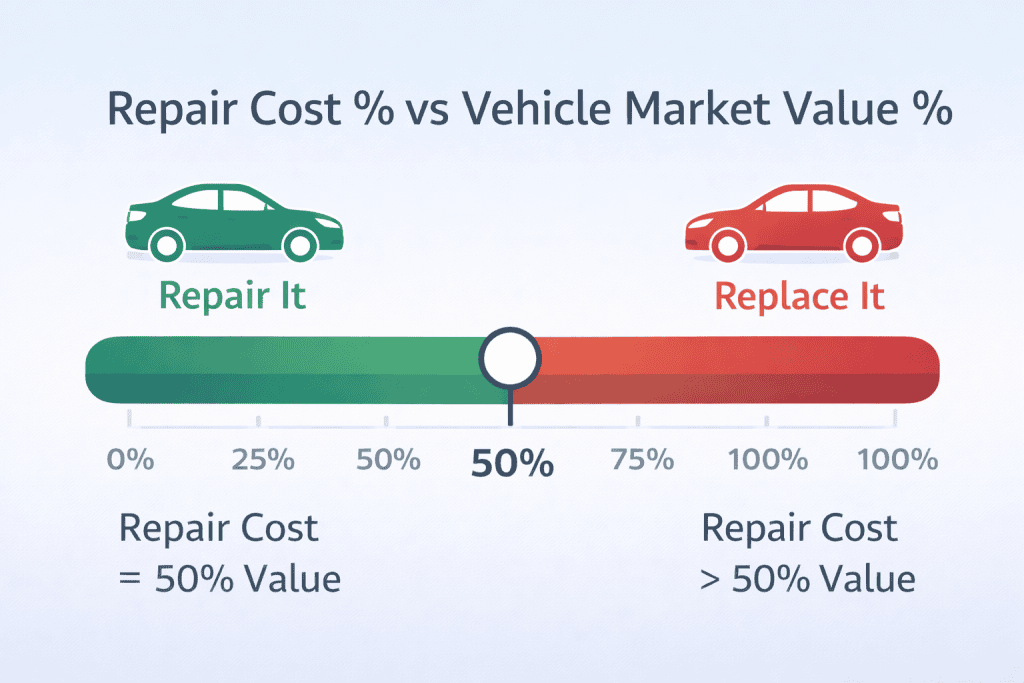
A widely used professional guideline suggests comparing repair costs directly to current vehicle value.
General benchmark:
- Repair under 30% of vehicle value → usually reasonable
- Repair between 30–50% → evaluate carefully
- Repair above 50% → replacement often safer financially
For instance:
- Vehicle value: $4,500
- Major engine repair: $2,600
Although repair remains technically possible, the financial exposure is high. Furthermore, aging vehicles commonly develop additional failures shortly after one major repair because surrounding components share similar wear levels.
Therefore, applying this comparison is one of the clearest steps in determining how much repair is too much for a car.
Warning Signs the Vehicle Is Becoming Financially Unsustainable
While cost comparisons help, failure patterns often provide stronger evidence.
Multiple Major Components Are Failing
If several critical systems begin failing within one year, reliability is declining rapidly.
Examples include:
- Cooling system failure followed by overheating damage
- Transmission slipping after prior drivetrain repair
- Persistent electrical faults affecting starting or sensors
Because these systems interact, each new failure increases the probability of another. Consequently, repeated major failures often indicate the vehicle is approaching the stage where owners must realistically ask when is a car not worth repairing.
Repair Frequency Is Increasing
A single large repair does not automatically justify replacement. However, recurring repairs within short intervals signal mechanical deterioration.
Watch for:
- Shop visits every few months
- Rising diagnostic complexity
- Increasing replacement of non-wear components
When yearly repair spending approaches the cost of financing a newer vehicle, the practical answer to should I repair my car or buy another one often becomes clearer.
Safety Reliability Is Declining
Financial decisions must never override safety considerations. If safety systems begin failing repeatedly, continued ownership may expose drivers to unnecessary risk.
Critical safety warnings include:
- Brake system instability
- Steering looseness or suspension structural damage
- Airbag warning lights that persist after repair
- Severe structural corrosion
Because these problems directly affect crash protection and control, ignoring them can lead to serious consequences.
How to Estimate Future Repair Risk
Before approving any major repair, ask the technician three critical questions:
- Are related components likely to fail soon?
- Does this repair fully restore long-term reliability?
- Is this model known for recurring failures at this mileage?
If the repair only postpones additional breakdowns, then continuing repairs may simply extend ownership costs without restoring dependability. Therefore, evaluating forward-looking risk is essential in understanding signs your car is not worth fixing.
When Repairing Still Makes Financial Sense
Despite high repair costs, replacement is not always the correct decision. Repairs may still be justified when:
- The vehicle retains strong resale value
- Maintenance history is well documented
- The repair permanently resolves the problem
- Insurance and ownership costs remain low
- Replacement financing would significantly increase monthly expenses
Thus, the correct answer to car repair vs replacement cost decision always depends on total ownership economics rather than a single invoice.
Consequences of Waiting Too Long
Delaying the decision after reliability begins collapsing often creates additional financial damage.
Common outcomes include:
- Sudden roadside breakdowns
- Emergency towing charges
- Secondary engine or drivetrain damage
- Rapid loss of trade-in value
- Increased safety risk during highway driving
Because deteriorating vehicles lose value quickly once reliability declines, early evaluation usually preserves more financial value than waiting for complete failure.
A Practical Decision Checklist
Before approving a major repair, confirm:
- Does the repair exceed roughly half the vehicle’s value?
- Have multiple major systems failed recently?
- Are safety components affected?
- Are repair visits becoming more frequent?
- Would replacing the vehicle reduce yearly ownership costs?
If several answers are yes, the vehicle may have reached the end of economical ownership.
Conclusion
Learning how to decide when repairing a car is no longer worth it requires evaluating repair costs, reliability trends, safety condition, and future expenses together. When major failures begin stacking, safety declines, or annual repair costs rival replacement ownership, continuing repairs often becomes financially unsound. Acting early protects both safety and long-term financial stability while preventing escalating unexpected expenses.