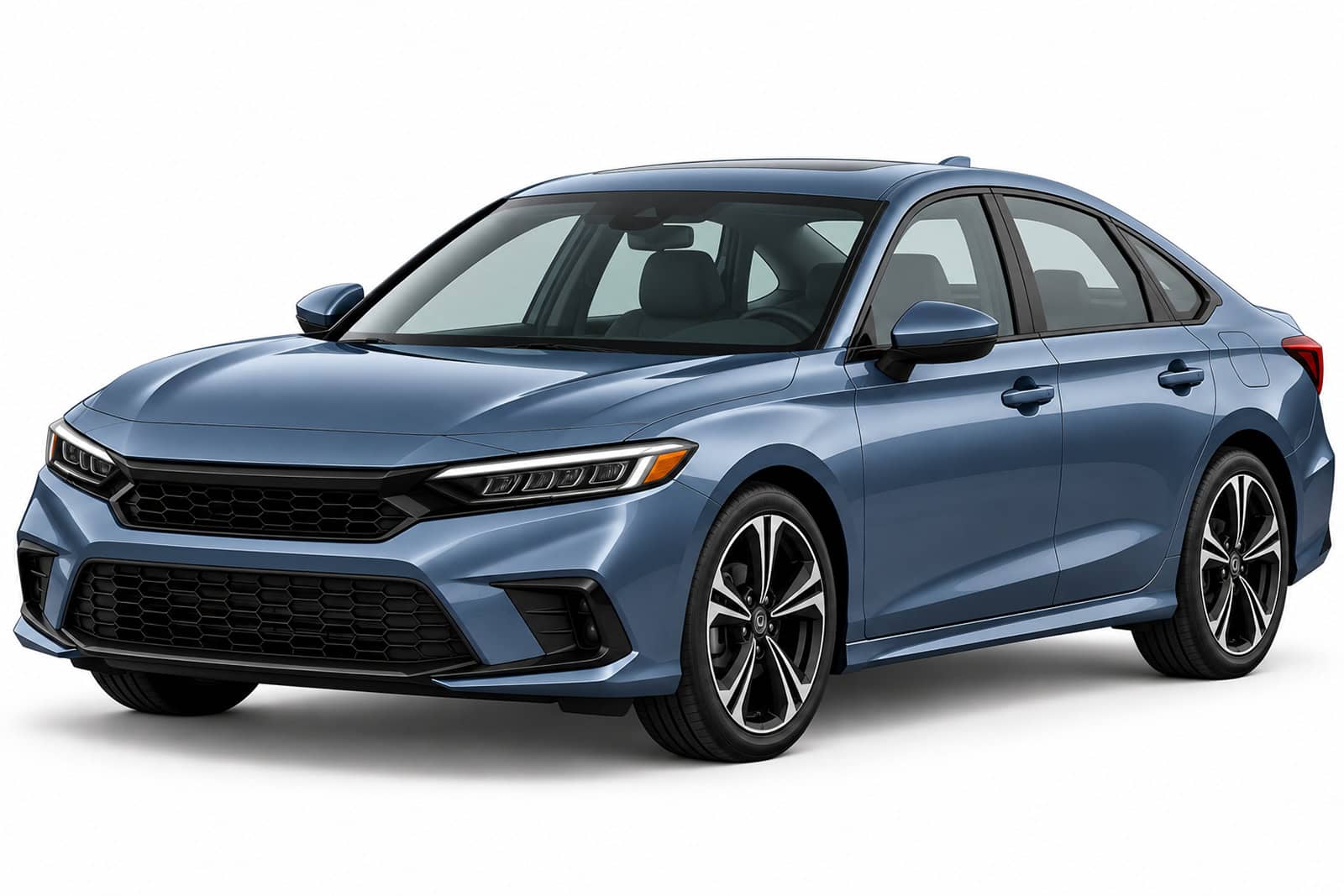
Owning a Honda Civic is usually straightforward, but the purchase price is only the beginning of what you will spend. Fuel, routine maintenance, tires, brakes, insurance, depreciation, and repairs all become part of the real cost of keeping the car. Your expenses can also change considerably depending on whether you own a 2.0L gasoline model, a 1.5L turbo, a hybrid, or an older Civic with higher mileage. This Honda Civic ownership guide looks at what U.S. and Canadian drivers can expect after bringing the car home. The supplied ownership figures focus mainly on 2012–2025 Civics. Your individual costs will depend on how far you drive, where you live, the condition of the car, and how well previous owners maintained it. A Civic can keep expenses manageable for many years, but even a reliable car still needs money set aside for normal wear and unexpected repairs.
What Honda Civic Ownership Actually Involves
Your regular Civic expenses extend beyond oil changes. You will pay for fuel, insurance, tires, brakes, filters, fluids, registration, and eventually parts that wear out with age. Depreciation also costs you money even though you never receive a bill for it. It is simply the value your Civic loses between the day you buy it and the day you sell or trade it. The advantage is that many of these expenses can be planned. Fuel use is relatively easy to estimate. Routine maintenance can be budgeted annually. Tires and brakes normally give you warning before replacement. Larger repairs are harder to predict, particularly as the Civic gets older. Keeping a separate repair fund prevents a worn suspension part or unexpected $800 repair from turning into a financial emergency.
Honda Civic Annual Maintenance Costs
For 2012–2025 Civics, the supplied figures put routine annual maintenance around $350–$650 in the United States and $450–$750 in Canada. Those amounts are useful for budgeting, but you should not expect to spend exactly the same amount every year. One year may only bring oil changes, filters, and a tire rotation. Another could include transmission fluid, brakes, tires, or another larger service. Higher-mileage cars naturally need a larger repair allowance because more components have had time to wear.
| Civic Ownership Situation |
United States |
Canada |
| Routine annual maintenance |
$350–$650 |
$450–$750 |
| Higher-mileage Civic |
$600–$900 |
$700–$1,000 |
| Hybrid model |
$350–$600 |
$450–$700 |
Why an Older Civic Can Cost More to Maintain
Mileage changes the type of expenses you should expect. A Civic with 40,000 miles may need little beyond scheduled maintenance and normal wear items. At 120,000 miles, you are dealing with a car whose suspension, wheel bearings, cooling-system parts, air-conditioning components, and other equipment have spent far more time on the road. That does not mean everything suddenly fails when the odometer crosses a particular number. It means you should leave more room in your budget for repairs. Service history can matter just as much as mileage. If you buy a Civic with 90,000 miles and no records, you may inherit overdue fluids, worn brakes, old tires, and neglected filters at the same time. Before buying a higher-mileage Civic, have it inspected and review whatever maintenance records are available. Spending money on an inspection before purchase is considerably nicer than discovering three overdue repairs during your first month of ownership.
Honda Civic Fuel Economy and Fuel Costs
Fuel can become one of your largest recurring Honda Civic ownership costs if you drive 12,000–20,000 miles per year. The supplied combined figures put recent 2.0L Civics around 31–33 mpg in the U.S., while 1.5L turbo versions are around 33–36 mpg. Hybrid models can reach approximately 48–50 mpg. Canadian figures are roughly 7.1–7.5 L/100 km for the 2.0L, 6.7–7.2 L/100 km for the 1.5L turbo, and 4.7–5.0 L/100 km for the hybrid. Exact ratings change by year and trim.
| Powertrain |
U.S. Combined |
Canada Combined |
| 2.0L four-cylinder |
~31–33 mpg |
~7.1–7.5 L/100 km |
| 1.5L turbo four-cylinder |
~33–36 mpg |
~6.7–7.2 L/100 km |
| Hybrid |
~48–50 mpg |
~4.7–5.0 L/100 km |
How Much Can the Civic Hybrid Save on Fuel?
The hybrid’s advantage becomes easier to understand when you turn fuel economy into annual fuel use. Suppose you drive 12,000 miles per year. At 32 mpg, a gasoline Civic would use about 375 U.S. gallons. At 49 mpg, a Civic Hybrid would use about 245 gallons. That is roughly 130 fewer gallons during the year. Multiply that difference by your local gasoline price and you have a much more useful estimate of potential savings. Canadian drivers can make the same calculation with kilometres and L/100 km. The more you drive, especially in conditions where the hybrid system operates efficiently, the more opportunity you have to recover a higher purchase price through lower fuel use. Do not choose the hybrid solely because its fuel-economy number is better. Compare the price difference first. Someone driving 25,000 km each year has much more fuel expense to reduce than someone driving only 6,000 km.
Honda Civic Insurance Costs
There is no useful single insurance price for every Civic owner. Your state or province, postal or ZIP code, age, driving record, annual mileage, coverage limits, deductible, claims history, and exact Civic can all change the premium. A Sport or Touring model can also cost differently to insure than a lower trim. This is why describing Civic insurance as simply cheap or expensive can be misleading. Two owners with identical cars can receive very different quotes. The supplied information describes U.S. Civic insurance as generally moderate, while Canadian rates range from moderate to somewhat higher depending on location. Ontario and British Columbia are identified as higher-cost markets, while Quebec can be lower. Get actual quotes before buying the car. Give the insurer the exact year and trim, or preferably the VIN when available. A 10-minute insurance quote can prevent an unpleasant monthly surprise that lasts for several years.
Honda Civic Depreciation and Resale Value
Depreciation is the money you lose as your Civic becomes worth less over time. If you buy a Civic for $30,000 and eventually sell it for $18,000, the $12,000 difference is part of your ownership cost even though you never wrote a $12,000 cheque. Age, mileage, condition, accident history, trim, local demand, and the used-car market all influence how quickly that value falls. The supplied information identifies resale value as one of the Civic’s ownership strengths, including demand for well-maintained higher-mileage cars and certain older manual-transmission models. You can help protect resale value by keeping service records, repairing damage, maintaining the interior, and avoiding neglected maintenance. If you want to examine the numbers in more detail, the Honda Civic depreciation guide looks specifically at Civic resale value over time.
Can a Honda Civic Last 200,000 Miles?
The supplied ownership information places a well-maintained Civic’s potential lifespan around 200,000–300,000 miles, or approximately 320,000–480,000 km. You should treat that as a possible long-term range rather than a promise. A car does not become guaranteed transportation to 300,000 miles simply because the trunk says Civic. Maintenance history, climate, previous repairs, accidents, driving conditions, and the individual powertrain all affect how long a particular car remains worth keeping. If you want your Civic to reach high mileage, concentrate on maintenance you can control. Change fluids when required. Do not ignore overheating. Maintain the brakes and tires. Investigate new noises and warning lights while problems are still small. CVT-equipped Civics also need the correct transmission-fluid service. Once the car becomes older, regular inspections help you catch worn parts before one neglected repair creates another.
What Usually Wears Out as a Civic Gets Older?
Long-term Civic ownership eventually becomes less about scheduled maintenance and more about wear. Brakes, tires, suspension parts, batteries, bearings, hoses, and other components have finite lives. Some may last well beyond 100,000 miles. Others can need attention much sooner because of road conditions or driving habits. You should expect occasional repairs as mileage increases rather than interpreting every worn component as evidence that the entire car has become unreliable.
- Brakes: Stop-and-go driving and winter corrosion can shorten pad and rotor life.
- Tires: Mileage, alignment, pressure, and driving style determine how quickly the tread disappears.
- Suspension: Bushings, shocks, and related components can wear as mileage and road impacts accumulate.
- Battery: Age and temperature extremes eventually reduce starting performance.
- Wheel bearings: Road conditions and mileage can contribute to bearing wear.
- Exhaust system: Age, moisture, and road salt can increase corrosion.
- Transmission: CVT-equipped Civics need the correct fluid service rather than a lifetime of neglect.
- Air conditioning: Older cars can eventually need diagnosis or repairs as components age.
Honda Civic Ownership in Canada
Canadian Civic ownership brings one expense that deserves special attention. Winter. Salt and moisture can accelerate corrosion underneath the car. Potholes and rough winter roads can also increase wear on tires, wheels, suspension parts, and alignment. The supplied annual maintenance range is $450–$750 for routine service and $700–$1,000 for higher-mileage Civics. Those numbers can rise in a year when tires, brakes, or corrosion-related repairs arrive together.
- Underbody: Inspect for rust and damaged protective coatings.
- Brakes: Salt can contribute to corrosion on rotors, lines, calipers, and related hardware.
- Suspension: Watch for wear after repeated pothole and rough-road impacts.
- Winter tires: Include purchase, seasonal installation, and eventual replacement in your budget.
- Battery: Very cold temperatures can expose a weakening battery.
- Exhaust: Check for corrosion as the car ages.
- Insurance: Compare actual quotes because costs can vary substantially between provinces and drivers.
Honda Civic Ownership in the United States
U.S. ownership conditions vary so much that national averages can hide what your Civic actually experiences. A car in Minnesota can spend months around road salt, snow, and freezing temperatures. A Civic in Arizona may instead face extreme heat, intense sunlight, and heavy air-conditioning use. Coastal areas add moisture and salt exposure. Your maintenance plan should reflect where the car lives rather than assuming every U.S. Civic has an easier life than one in Canada.
- Northern states: Inspect brakes, suspension, exhaust parts, and the underbody for winter corrosion.
- Hot states: Pay attention to the battery, cooling system, tires, and air conditioning.
- Heavy-traffic areas: Expect greater brake wear and potentially higher insurance costs.
- High annual mileage: Budget more for tires, fluids, oil changes, and other mileage-related maintenance.
- Low annual mileage: Continue age-based maintenance even when the odometer rises slowly.
- Insurance: Get quotes for your exact Civic because location and driver history can outweigh the vehicle’s national averages.
What Has the Biggest Effect on Honda Civic Ownership Costs?
The amount you drive has an obvious effect on fuel and maintenance, but previous maintenance can be just as important when you buy used. A neglected Civic can quickly erase the savings you expected from choosing an inexpensive compact car. Climate also matters. Canadian winters and northern U.S. road salt can increase corrosion costs. Hot climates place different demands on batteries, tires, cooling systems, and air conditioning. Insurance can then add hundreds or even thousands of dollars to the annual difference between two owners.
- Annual mileage: More driving means more fuel and faster accumulation of mileage-based service.
- Previous maintenance: Missed service can leave you paying for work the last owner postponed.
- Powertrain: Gasoline, turbocharged, CVT, manual, and hybrid Civics have different ownership needs.
- Climate: Salt, cold, heat, moisture, and rough roads change how components age.
- Tires and brakes: Driving style and road conditions can move replacement dates significantly.
- Insurance location: Your ZIP or postal code can have a major effect on premiums.
- Vehicle condition: Accident damage, rust, worn parts, and neglected repairs increase future spending.
- Depreciation: Purchase price and eventual resale value affect your total cost even when monthly expenses stay low.
Buying a Used Civic Without Inheriting Someone Else’s Bills
A used Civic’s condition matters more than its reputation. Before buying, check service records and compare them with the current mileage. Confirm that oil changes and transmission service have been kept up to date. Look at tire condition and brake wear. Check underneath the car for corrosion if it has lived where road salt is common. You should also investigate warning lights rather than accepting the familiar line that “it probably just needs a sensor.” A pre-purchase inspection can uncover repairs that are difficult to spot during a short test drive. You should also check the VIN for unresolved safety recalls. U.S. shoppers can use the NHTSA recall lookup. Canadian shoppers can check Transport Canada’s vehicle recall information. For a broader look at model years, trims, costs, and known concerns, the Honda Civic buying guide can help you narrow the search before you inspect individual cars.
Honda Civic Ownership Budget
A useful Civic budget should include predictable expenses and leave room for the unpredictable ones. Fuel and insurance arrive regularly. Maintenance is less consistent. You might spend very little for several months and then need tires, brakes, and a scheduled fluid service close together. Higher-mileage owners should keep a larger repair reserve because age-related parts become more likely to need attention. If you are comparing two Civics, do not look at the purchase price alone. Estimate annual fuel use. Get insurance quotes. Review maintenance history. Check tire and brake condition. Consider depreciation if you expect to sell within a few years. Then leave money available for repairs. That gives you a far clearer picture of Honda Civic ownership than assuming a Civic will automatically be cheap simply because the model has a strong reputation.