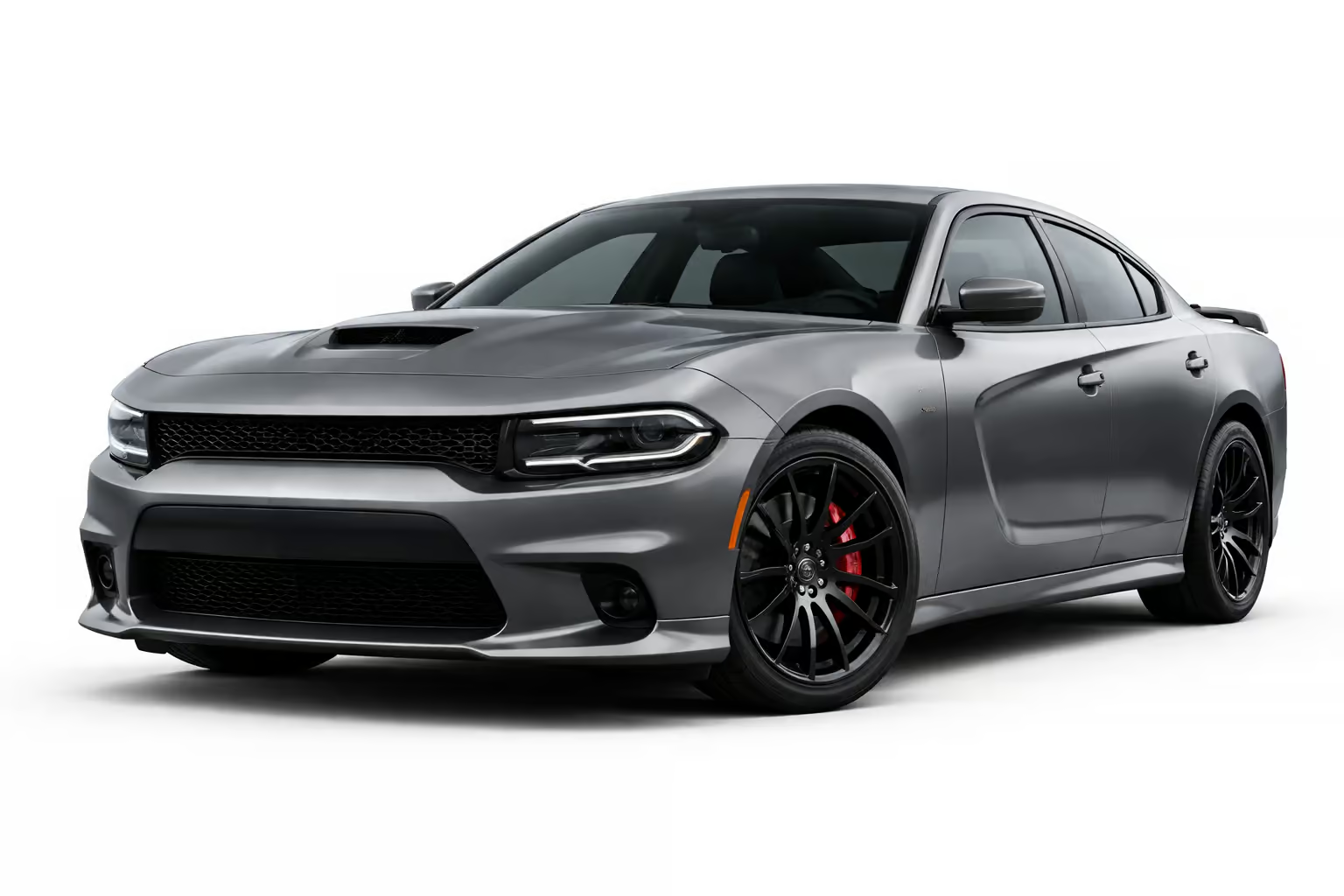
The Dodge Charger trim lineup gives you a much wider performance range than you normally find in a four door sedan. In the final years of the previous generation, you could choose anything from a 3.6L V6 with available AWD to a supercharged 6.2L V8 producing more than 800 hp. That makes the trim badge especially important when you are shopping used. Two Chargers can look similar from a distance while having completely different engines, brakes, tires, fuel costs, and driving characteristics.
This guide focuses on the previous generation Dodge Charger and its late model trim structure, including the 2023 model year, rather than the newer Charger lineup that replaced it. That distinction matters because names such as R/T, Scat Pack, SRT Hellcat, Redeye, and Jailbreak changed considerably as Dodge moved away from the previous Charger platform. If you are researching a used Charger, the trim level is one of the first details you should confirm.
Dodge Charger Trim Hierarchy Overview
The Charger lineup starts with V6 models and moves progressively into increasingly powerful V8 trims. SXT and GT models are the main choices when you want AWD. The R/T introduces the 5.7L HEMI V8. Scat Pack models make a much larger jump to the naturally aspirated 6.4L HEMI V8. Hellcat versions move into supercharged territory. At the top, Redeye and Jailbreak versions push output beyond what most four door cars will ever see. Here is the basic late model hierarchy you will encounter when shopping in the U.S. or Canada.
| Charger trim |
Engine |
Horsepower |
Drive |
Main purpose |
| SXT |
3.6L V6 |
292 hp |
RWD / AWD |
Entry level |
| GT |
3.6L V6 |
300 hp |
RWD / AWD |
Sport styled V6 |
| R/T |
5.7L HEMI V8 |
370 hp |
RWD |
Entry V8 |
| Scat Pack |
6.4L HEMI V8 |
485 hp |
RWD |
High performance V8 |
| Scat Pack Widebody |
6.4L HEMI V8 |
485 hp |
RWD |
Wider performance setup |
| SRT Hellcat Widebody |
Supercharged 6.2L V8 |
717 hp* |
RWD |
Supercharged performance |
| SRT Hellcat Redeye Jailbreak |
Supercharged 6.2L V8 |
Up to 807 hp* |
RWD |
Maximum late model output |
*Output varies by model year and specific Hellcat configuration.
The jump between trims is therefore much more than cosmetic. Moving from a 292 hp SXT to a 485 hp Scat Pack adds 193 hp. Moving from that Scat Pack into an 807 hp Redeye Jailbreak adds another 322 hp. You should compare the exact model year as well as the trim because Dodge changed packages, standard equipment, horsepower ratings, and available configurations during the generation.
Dodge Charger SXT and SXT AWD
The Charger SXT is where the lineup becomes easiest to live with if maximum horsepower is not your priority. Its 3.6L Pentastar V6 produces about 292 hp and 260 lb ft of torque in the standard configuration. An 8 speed automatic transmission handles shifting. Unlike the V8 trims, the SXT could also be configured with AWD during the later years of this Charger generation. That makes it particularly useful if you regularly drive through snow, although AWD availability was not limited to Canada.
- Engine: 3.6L Pentastar V6
- Output: About 292 hp and 260 lb ft
- Transmission: 8 speed automatic
- Drivetrain: RWD or available AWD, depending on year and market
- Seating: 5 passengers
- Interior: Cloth seating in the standard configuration
- Position: Entry Charger trim
- Best suited to: Everyday driving and buyers who want available AWD
You give up the sound and acceleration of the V8 models, but you also avoid buying more engine than you actually need. An SXT can make considerably more sense if your Charger will spend most of its life commuting, carrying passengers, and dealing with winter roads. When buying used, confirm whether the vehicle is RWD or AWD instead of assuming from the SXT badge alone.
Dodge Charger GT and GT AWD
The GT keeps the 3.6L V6 but gives the Charger a noticeably more aggressive appearance. Output is commonly rated at 300 hp and 264 lb ft of torque in late model versions. That is only a small increase over the standard SXT, so you should not buy a GT expecting Scat Pack acceleration. The real appeal is getting much of the performance inspired appearance without moving into V8 fuel consumption and ownership costs.
- Engine: 3.6L Pentastar V6
- Output: About 300 hp and 264 lb ft
- Transmission: 8 speed automatic
- Drivetrain: RWD or AWD, depending on configuration
- Wheels: Larger sport oriented wheels than basic SXT configurations
- Appearance: Performance inspired exterior treatment
- Interior: Upgraded sport themed equipment and available options
- Best suited to: Buyers who want Charger styling with V6 power
GT AWD is especially interesting if you like the appearance of the higher Charger trims but live somewhere that regularly sees snow. Just remember that the aggressive bodywork does not turn the V6 into a hidden Hellcat. You still have roughly 300 hp rather than the 370 hp of the R/T or 485 hp of the Scat Pack.
Dodge Charger R/T
The R/T is where the traditional V8 Charger experience begins. Its 5.7L HEMI V8 produces about 370 hp and 395 lb ft of torque in late model versions. Power goes to the rear wheels through an 8 speed automatic transmission. The R/T also gives you the V8 exhaust note that many buyers associate with the Charger without requiring you to jump immediately into the 6.4L Scat Pack.
- Engine: 5.7L HEMI V8
- Output: About 370 hp and 395 lb ft
- Transmission: 8 speed automatic
- Drivetrain: RWD
- Performance equipment: V8 specific exhaust and performance equipment
- Position: First V8 step in the regular lineup
- Best suited to: Buyers who specifically want a HEMI V8 without Scat Pack power
There is a meaningful difference between the R/T and GT. You gain roughly 70 hp and 131 lb ft of torque when comparing common late model specifications. You should also expect higher fuel use and potentially higher running costs. If you are researching one as a used vehicle, the Dodge Charger ownership cost guide gives you a better picture of expenses beyond the purchase price.
Dodge Charger Scat Pack
The Scat Pack is one of the biggest jumps in the Charger hierarchy. Under the hood is a naturally aspirated 6.4L HEMI V8, also known as the 392, producing 485 hp and 475 lb ft of torque. That gives you 115 hp more than the 5.7L R/T. You also get performance hardware designed to support the additional output rather than simply receiving a larger engine.
- Engine: 6.4L HEMI V8
- Output: 485 hp and 475 lb ft
- Transmission: 8 speed automatic
- Drivetrain: RWD
- Brakes: Brembo performance braking equipment
- Cooling: Additional performance cooling equipment
- Performance equipment: More aggressive suspension and performance systems
- Best suited to: Buyers wanting naturally aspirated V8 performance
I spent some time comparing the numbers across the Charger range, and this is where the power progression becomes particularly obvious. The SXT begins around 292 hp. The R/T reaches 370 hp. The Scat Pack jumps all the way to 485 hp without a supercharger. That is why you should treat the Scat Pack as a substantially different performance car rather than simply an upgraded R/T.
Dodge Charger Scat Pack Widebody
The Scat Pack Widebody does not give you a larger engine or additional horsepower over the regular Scat Pack. You still get the 6.4L HEMI V8 with 485 hp and 475 lb ft. The important changes happen around the car. Wide fender flares allow much wider wheels and tires, while the suspension and braking setup are designed to make better use of the available grip.
- Engine: 6.4L HEMI V8
- Output: 485 hp and 475 lb ft
- Drivetrain: RWD
- Body: Factory widebody fender extensions
- Wheels: Approximately 20 x 11 inches on common late model configurations
- Tires: Approximately 305 mm wide on common configurations
- Brakes: Brembo performance brakes
- Best suited to: Buyers who value additional tire width and handling capability
Those 305 mm tires are a major difference from ordinary Charger rubber. More tire can help put 485 hp onto the road, but replacement costs also deserve your attention. Check all four tires closely when inspecting a used Widebody. Uneven wear, mismatched tires, or a nearly bald rear pair can turn your first week of ownership into an unexpectedly expensive tire shopping trip.
Dodge Charger SRT Hellcat Widebody
The Hellcat changes the personality of the Charger again. Instead of relying on a naturally aspirated HEMI, it uses a supercharged 6.2L V8. Late model SRT Hellcat Widebody versions reached roughly 717 hp and 650 lb ft of torque, although exact output depends on model year and configuration. Power still goes exclusively to the rear wheels, which makes tires, road conditions, and throttle control rather important when hundreds of horsepower arrive at your right foot.
- Engine: Supercharged 6.2L HEMI V8
- Output: Around 717 hp and 650 lb ft on applicable versions
- Transmission: Heavy duty 8 speed automatic
- Drivetrain: RWD
- Body: Widebody performance configuration on later models
- Brakes: Large Brembo performance brakes
- Cooling: High performance engine and cooling systems
- Best suited to: Buyers specifically seeking supercharged Charger performance
A Hellcat is not simply a faster Scat Pack. The supercharged engine, cooling requirements, tires, brakes, insurance, and fuel consumption create a different ownership proposition. If you are considering a used one, service history becomes particularly important. You should also investigate previous modifications because these cars are understandably tempting to modify.
Dodge Charger SRT Hellcat Redeye and Jailbreak
Redeye and Jailbreak versions sit near the extreme end of the previous generation Charger range. The high output supercharged 6.2L HEMI could produce as much as 807 hp in applicable Redeye Jailbreak configurations. That is nearly 3 times the output of an entry SXT. Jailbreak also opened additional factory customization choices, allowing buyers to combine colours, wheels, stripes, interior treatments, and other equipment that had previously been restricted to particular combinations.
- Engine: High output supercharged 6.2L HEMI V8
- Output: Up to approximately 807 hp on applicable Redeye Jailbreak models
- Drivetrain: RWD
- Transmission: 8 speed automatic
- Body: Widebody configuration
- Customization: Expanded factory colour and equipment combinations
- Position: Among the highest performance late model Charger configurations
- Best suited to: Buyers specifically seeking the highest output versions
At this level, the trim name matters enormously. Hellcat, Redeye, Widebody, and Jailbreak labels are not interchangeable. Verify the VIN, original equipment, engine specification, and model year before paying a premium for a rare configuration. A badge is cheap. An actual 807 hp factory drivetrain most certainly is not.
What Each Dodge Charger Trim Adds
Moving through the Charger trims changes the engine first, but equipment, tire size, braking capability, exterior design, and interior options also progress. The important point is that the steps are not equal. SXT to GT is primarily a V6 equipment and styling move. GT to R/T introduces V8 power. R/T to Scat Pack makes a substantial performance jump. Hellcat models then add supercharging and another major increase in output.
|
Moving to this trim
|
Main change
|
|
SXT
|
3.6L V6 entry point with available AWD
|
|
GT
|
300 hp V6 with more aggressive styling and equipment
|
|
R/T
|
5.7L HEMI V8 with 370 hp
|
|
Scat Pack
|
6.4L HEMI V8 with 485 hp and stronger performance hardware
|
|
Scat Pack Widebody
|
485 hp plus wider body, wheels and tires
|
|
SRT Hellcat Widebody
|
Supercharged 6.2L V8 with roughly 717 hp on applicable models
|
|
Redeye / Jailbreak
|
High‑output supercharged V8 with as much as 807 hp on applicable versions
|
This progression gives you a simple way to narrow your search. If AWD is essential, concentrate on compatible V6 configurations. If a V8 is the reason you want a Charger, start your comparison at R/T. If naturally aspirated performance matters more than maximum horsepower, look closely at Scat Pack models. Hellcat and Redeye versions make more sense when extreme output is specifically part of what you want.
Dodge Charger AWD vs RWD Trim Availability
Drivetrain choice separates the V6 and V8 sides of the late model Charger lineup. SXT and GT configurations could be purchased with AWD during applicable model years. The R/T, Scat Pack, Scat Pack Widebody, Hellcat, and Redeye performance models use RWD. This matters considerably in Canada and northern U.S. states because choosing AWD generally means choosing the 3.6L V6 as well.
| Trim |
RWD |
AWD |
| SXT |
Yes |
Available |
| GT |
Yes |
Available |
| R/T |
Yes |
No |
| Scat Pack |
Yes |
No |
| Scat Pack Widebody |
Yes |
No |
| SRT Hellcat |
Yes |
No |
| Redeye / Jailbreak |
Yes |
No |
AWD can help you get moving on slippery roads, but tires remain extremely important. A Charger with AWD and poor tires can still struggle to stop or turn on snow and ice. If winter driving is your main reason for considering an SXT AWD or GT AWD, budget for a good set of winter tires rather than treating the AWD badge as a substitute for them.
Dodge Charger Trim Differences in the U.S. and Canada
U.S. and Canadian Charger lineups shared the same basic mechanical foundation, but trim availability, packages, standard equipment, pricing, and dealer inventory could differ by model year. AWD SXT and GT Chargers are especially relevant to Canadian buyers because of winter conditions, but AWD versions were also sold in the United States. You should therefore avoid treating SXT AWD or GT AWD as Canada only models.
The same caution applies to high performance trims. R/T, Scat Pack, Hellcat, Redeye, and special editions were offered in both markets at various points, but availability was not identical every year. Canadian pricing was also not a simple currency conversion of U.S. MSRP. When checking an original vehicle, use its model year and market specific window sticker or build information rather than applying another year’s trim list.
Dodge Charger Trim Performance Comparison
Horsepower makes the differences between Charger trims easy to see, but torque deserves attention too. The 3.6L V6 provides enough output for ordinary driving. The 5.7L R/T increases low speed V8 response. The 6.4L Scat Pack adds another substantial step. Supercharged Hellcat engines then move into an entirely different performance category.
| Trim |
Engine |
Horsepower |
Torque |
| SXT |
3.6L V6 |
292 hp |
260 lb ft |
| GT |
3.6L V6 |
300 hp |
264 lb ft |
| R/T |
5.7L HEMI V8 |
370 hp |
395 lb ft |
| Scat Pack |
6.4L HEMI V8 |
485 hp |
475 lb ft |
| Scat Pack Widebody |
6.4L HEMI V8 |
485 hp |
475 lb ft |
| SRT Hellcat Widebody* |
Supercharged 6.2L V8 |
About 717 hp |
About 650 lb ft |
| Redeye Jailbreak* |
Supercharged 6.2L V8 |
Up to 807 hp |
About 707 lb ft |
*Hellcat specifications vary by model year and exact configuration.
You can see why comparing Chargers solely by appearance is a mistake. There is a 515 hp difference between a 292 hp SXT and an 807 hp Redeye Jailbreak. For additional background on reliability before choosing one of these engines, the Charger reliability guide covers the broader ownership picture.
Dodge Charger Trim Pricing in the U.S. and Canada
Charger pricing requires model year context. Dodge changed MSRP, packages, special editions, and performance configurations throughout the generation. The previous generation also ended after the 2023 model year, so current used prices no longer follow the original trim hierarchy neatly. Mileage, condition, accident history, modifications, service records, colour, and rarity can now have a major effect on what a particular Charger costs.
|
Relative price position
|
Charger trim
|
|
Lowest
|
SXT / SXT AWD
|
|
Lower
|
GT / GT AWD
|
|
Middle
|
R/T
|
|
Upper
|
Scat Pack
|
|
Upper performance
|
Scat Pack Widebody
|
|
High
|
SRT Hellcat Widebody
|
|
Highest
|
Redeye / Jailbreak and limited configurations
|
This is one area where you should not rely on a generic MSRP number without checking the year. A rare used Hellcat can behave very differently in the market from an ordinary SXT. The same applies to depreciation. You can use the Charger depreciation breakdown to see how value retention fits into the larger ownership decision.
Which Dodge Charger Trim Should You Choose?
The right Dodge Charger trim depends mainly on whether you prioritize AWD, V8 power, naturally aspirated performance, or maximum supercharged output. An SXT AWD or GT AWD makes the strongest case when all weather traction is central to your search. GT gives you the sportier appearance while retaining the V6. R/T is the first stop when having a HEMI V8 matters. Scat Pack provides 485 hp without moving into a supercharged engine. Scat Pack Widebody retains that output while adding substantially wider tires and bodywork. Hellcat and Redeye models are the choices to investigate when maximum performance outweighs fuel, tire, insurance, and other running costs.
Before buying, compare the trim against the exact VIN and factory equipment. You can also work through the Dodge Charger buyer’s guide before deciding on a model year. For safety information and recall research, the U.S. government’s NHTSA vehicle database lets you search by year, make, and model. That final check matters because choosing the right Charger is not just about finding the biggest horsepower number. It is about finding the version whose drivetrain, equipment, condition, and ownership costs actually fit how you plan to use it.