Understanding Toyota Camry depreciation over 5 years is essential if you plan to sell, trade in, or finance strategically. Depreciation is usually the largest ownership expense — often exceeding fuel, insurance, and routine maintenance combined. Because of that, timing and resale awareness directly affect your total cost of ownership.
Most drivers don’t notice depreciation while driving the car. They feel it when they try to sell.
How Much Does a Toyota Camry Depreciate in 5 Years?
On average, a Toyota Camry loses 35% to 45% of its value over five years, depending on mileage, condition, and market demand.
Example:
Original MSRP: $30,000
Estimated value after 5 years: $16,500–$19,500
Total depreciation: $10,500–$13,500
The first year is typically the steepest drop. A new Camry can lose 15%–20% once it transitions from “new” to “used.” That shift happens the moment it is registered, even if mileage is low.
In practice, owners who trade in within the first 24 months often absorb the most aggressive depreciation phase. That’s where financial planning matters.
How Camry Depreciation Compares to Other Sedans
Depreciation only makes sense in context.
Compared to the average midsize sedan — which often loses closer to 45%–50% over five years — the Toyota Camry depreciation rate tends to perform slightly better than segment averages.
Against competitors like the Honda Accord, depreciation is typically comparable, though market cycles can shift short-term results. Both vehicles benefit from strong reliability perception and high used-market demand.
What matters most is that the Camry consistently sits in the upper tier for midsize sedan resale value. That reputation supports pricing stability in years three through five.
Buyers trust longevity. That trust supports value.
Why the First Two Years Matter Most
Sometimes the first sign of depreciation shock appears during early trade-in evaluation.
An owner who buys new at $30,000 and trades in at 24 months may face resale values closer to $22,000–$24,000 depending on mileage and market conditions. That means absorbing the steepest decline in the shortest timeframe.
However, an owner who buys the same Camry at three years old and sells at five may lose far fewer dollars overall. The steepest curve has already flattened by then.
That’s strategic ownership timing.
The reality is simple: buying lightly used often shifts depreciation risk to the first owner.
What Accelerates Camry Depreciation?
Even strong resale vehicles can lose value faster under certain conditions.
High Mileage
Driving 20,000+ miles per year instead of the market average 12,000–15,000 pushes value toward the lower end of the five-year depreciation range.
Accident History
Collision records reduce buyer confidence. According to valuation insights from Kelley Blue Book, accident history directly impacts resale grading and pricing.
Poor Maintenance Documentation
Missing service records can weaken buyer trust. Because of that, buyers often assume higher future repair risk and negotiate lower offers.
One common scenario: an owner delays transmission fluid service because the car “feels fine.” Years later, minor hesitation develops, and resale value drops more than expected. Small maintenance decisions can influence long-term resale leverage.
Estimated 5-Year Depreciation Timeline
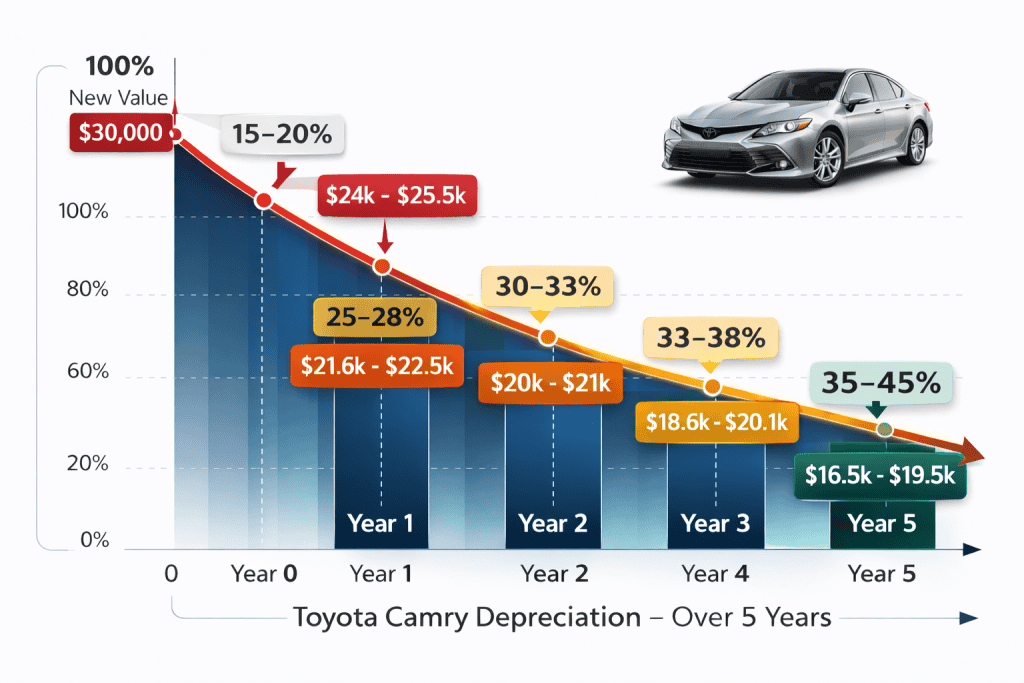
Toyota Camry depreciation chart over five years showing value decline curve with small silver Camry illustration and percentage loss from year 1 to year 5.
Typical depreciation progression:
Year 1: 15–20% loss
Year 2: 25–28% total loss
Year 3: 30–33% total loss
Year 4: 33–38% total loss
Year 5: 35–45% total loss
After year five, depreciation slows significantly. That’s when many owners notice resale stabilizing — although maintenance costs begin rising.
That’s the tradeoff.
Financial Risk: Negative Equity in Early Ownership
Depreciation becomes more serious when financing is involved.
If a buyer finances $30,000 with minimal down payment, the Camry may be worth less than the remaining loan balance during the first one to two years. That creates negative equity if the vehicle must be sold early.
For example, if the car’s value drops to $23,000 but the remaining loan balance is $25,000, the owner must cover the difference to exit the loan.
That financial gap catches many first-time buyers off guard.
Understanding vehicle depreciation timing helps prevent this situation.
How to Minimize Camry Depreciation
You cannot stop depreciation, but you can manage it.
Maintain consistent service records
Avoid excessive annual mileage
Protect exterior and interior condition
Sell before major wear components stack
Around year five, items like suspension parts, brakes, and tires may require replacement simultaneously. If those costs begin stacking, resale flexibility shrinks.
One repair often leads to another.
Selling slightly before major maintenance cycles can protect financial return.
When Is the Best Time to Sell a Camry?
From a pure depreciation standpoint, years 3 to 5 often represent the optimal balance between value retention and rising ownership costs.
Early steep losses have already occurred
Reliability perception remains strong
Major age-related repairs may not yet be required
For many drivers, waiting too long shifts the balance from depreciation loss to maintenance accumulation.
Timing matters more than most people realize.
Final Perspective
The Toyota Camry depreciation over 5 years remains moderate compared to many competitors, yet the early years carry the greatest financial impact.
By understanding:
Percentage loss curves
Market comparisons
Financing risk
Ownership timing strategies
you can reduce long-term ownership cost and avoid preventable equity loss.
This platform analyzes depreciation trends, resale value behavior, and long-term ownership costs, helping drivers understand how mileage, maintenance, and timing shape real financial outcomes.