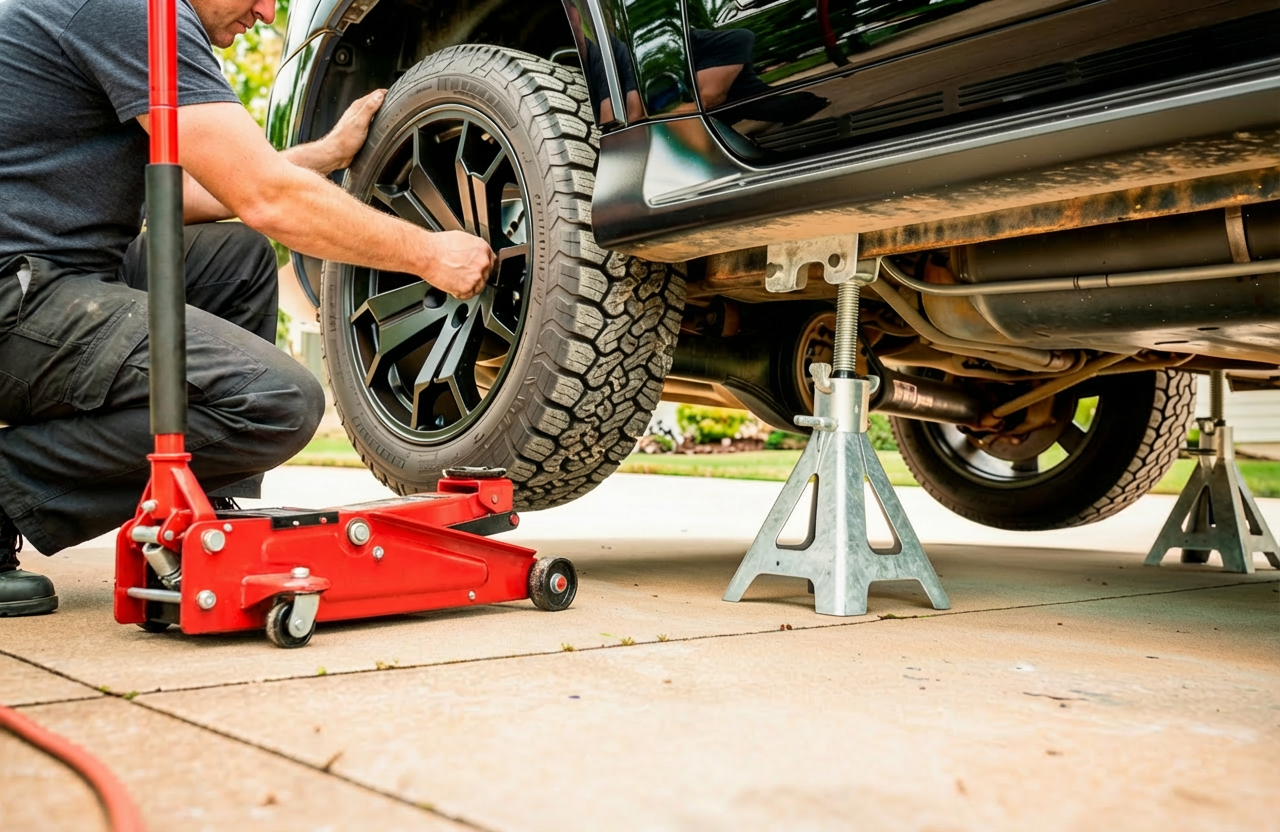
Vehicle safely lifted with jack stands for tire rotation procedure.
Rotating your tires is a simple but essential maintenance task that helps extend tire life, improve handling, and ensure even tread wear. While tire rotation patterns can vary slightly by vehicle, the basic process is similar for most cars, SUVs, and light trucks. This guide walks you through the steps clearly—even if you’ve never done it before.
What Tire Rotation Does (and Why It Matters)
Tires wear differently depending on their position on the vehicle. Front tires often wear faster due to steering, braking, and engine weight, while rear tires may wear more evenly.
Regular tire rotation helps:
✔ Promote even tread wear
✔ Extend overall tire lifespan
✔ Maintain balanced handling and traction
✔ Reduce road noise and vibration
✔ Support safer braking performance
Skipping tire rotations can lead to premature tire replacement and uneven driving behavior.
What You’ll Need Before You Start
Before beginning, gather the following:
✔ A vehicle jack and jack stands
✔ A lug wrench or tire iron
✔ Wheel chocks or sturdy blocks
✔ Your vehicle owner’s manual (recommended)
Work on a flat, level surface with the parking brake fully engaged.
Step 1: Park the Vehicle and Prepare Safely
Park on a level surface and turn the engine off completely. Engage the parking brake and place wheel chocks behind the tires that will remain on the ground.
If your wheels have decorative covers or hubcaps, remove them now.
Beginner tip: On most vehicles, loosening the lug nuts slightly before lifting the car makes removal much easier and prevents the wheel from spinning.
Step 2: Loosen the Lug Nuts (Do Not Remove Yet)
Using a lug wrench, turn each lug nut counterclockwise about a quarter turn while the vehicle is still on the ground. This breaks the initial resistance safely.
Do not fully remove the lug nuts at this stage.
Step 3: Lift the Vehicle Securely
Position the jack at the manufacturer-recommended lift point and raise the vehicle. Once lifted, place jack stands underneath for support before lowering the vehicle onto them.
Important workflow note for beginners: Never rely on the jack alone—jack stands are essential for stability and safety while working around the wheels.
Step 4: Remove the Wheels
Fully remove the loosened lug nuts and carefully take off each wheel. Place the wheels flat on the ground nearby so you can keep track of their original positions.
Step 5: Rotate the Tires to Their New Positions
Follow a standard rotation pattern unless your owner’s manual specifies otherwise.
For most front-wheel-drive vehicles:
✔ Front tires move straight to the rear
✔ Rear tires move to the opposite front corners
For rear-wheel or all-wheel drive vehicles, patterns may differ. Always follow manufacturer guidance when available.
Step 6: Reinstall the Wheels
Mount each wheel onto its new position and hand-thread the lug nuts to avoid cross-threading.
Tighten the lug nuts lightly in a star or crisscross pattern to seat the wheel evenly.
Beginner workflow tip: If the wheel doesn’t sit flush, gently wiggle it into place before tightening—this prevents uneven tightening later.
Step 7: Lower the Vehicle and Tighten Lug Nuts
Lower the vehicle back onto the ground. Once fully lowered, use the lug wrench to tighten the lug nuts securely in the same star pattern.
For best results, use a torque wrench set to the manufacturer’s recommended torque specification.
How Often Should Tires Be Rotated?
Most manufacturers recommend rotating tires every 5,000 to 8,000 miles, or at every other oil change.
Rotation is especially recommended if you notice:
✔ Uneven tread wear
✔ Increased road noise
✔ Steering vibration
Regular inspections during rotations help catch alignment or suspension issues early.
Final Notes for Beginners
Tire rotation is a straightforward task when done carefully and methodically. Taking your time, using proper safety equipment, and following a consistent workflow makes the process safe and repeatable for most vehicles.
This guide is provided for general educational purposes only and does not replace manufacturer service instructions or professional advice.