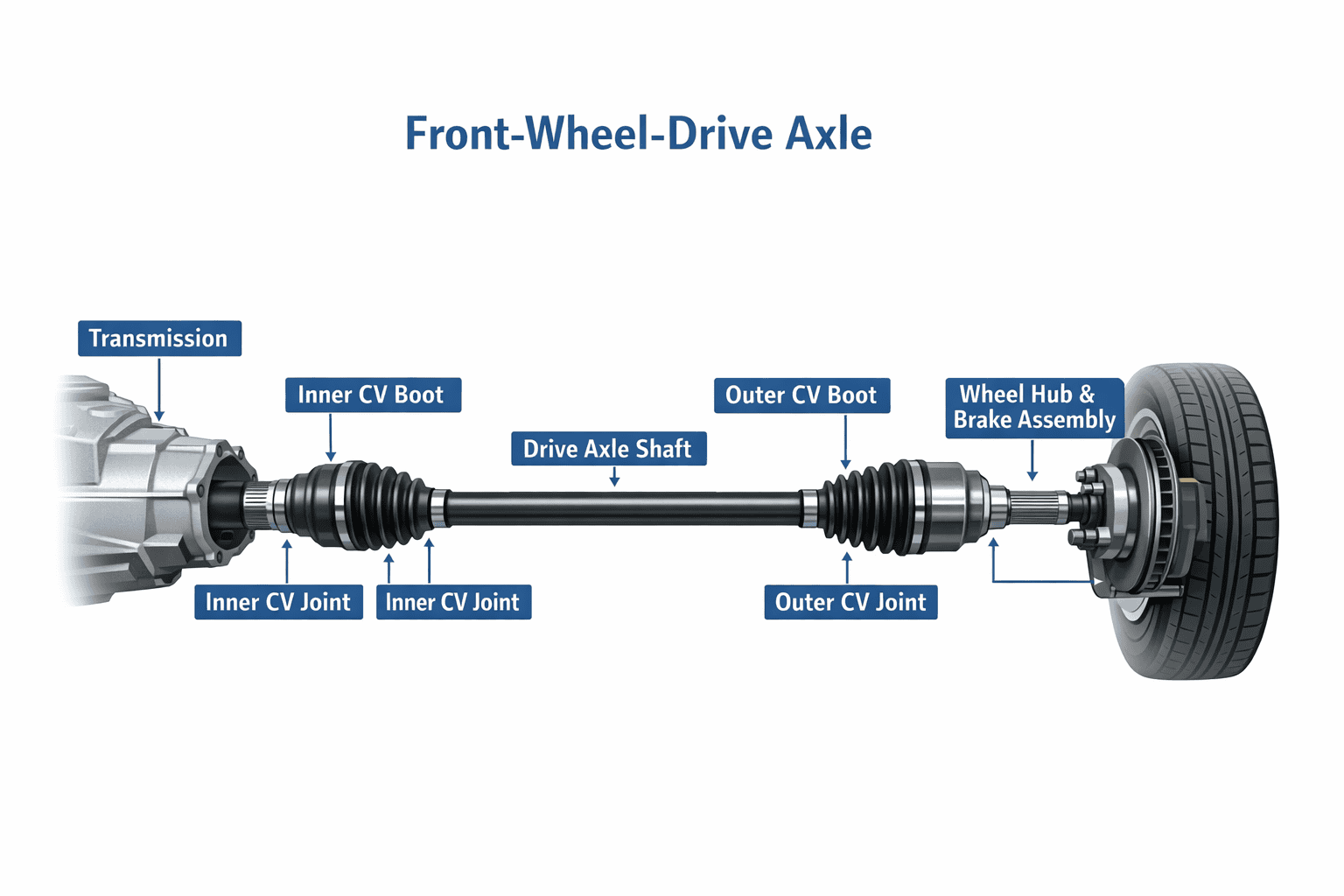
Constant velocity (CV) joints and axles play a vital role in delivering engine power to the wheels while still allowing smooth movement during steering and suspension travel. When these components begin to wear, noise is usually the first warning sign. Therefore, learning how to recognize CV joint or axle noise early can help prevent breakdowns, secondary drivetrain damage, and unsafe driving conditions.
Because these issues often develop gradually, many drivers initially mistake early symptoms for tire imbalance or brake-related problems. However, understanding the specific sounds and driving conditions linked to CV joint and axle wear makes diagnosis far more accurate. This knowledge also fits into a broader understanding of How the Drivetrain Works (And Why It Matters), where multiple components work together to transfer power efficiently.
What CV Joints and Axles Do
CV joints are flexible couplings located at each end of a drive axle. Their job is to deliver consistent torque to the wheels, even as the suspension moves and the wheels turn. As a result, they are engineered to operate quietly under significant load.
Over time, however, protective rubber boots can crack or tear. When grease escapes and contaminants enter the joint, internal wear accelerates quickly. Consequently, noise becomes noticeable long before total failure occurs.
Common CV Joint and Axle Noises to Watch For
1. Clicking or Popping While Turning
A rhythmic clicking or popping noise during sharp turns—especially at low speeds—is one of the most recognizable CV joint symptoms. This sound typically originates from a worn outer CV joint.
For example, the noise may become more noticeable when turning left or right while exiting a parking space. As wear progresses, the clicking usually becomes more frequent and louder. These symptoms are also covered in detail in Common Causes of Clicking Noise When Turning, which helps differentiate steering-related noises from drivetrain faults.
2. Clunking When Accelerating or Shifting
A worn or damaged axle can produce a dull clunk when accelerating from a stop or shifting between drive and reverse. In some cases, this noise may feel like a brief jolt through the floor.
Additionally, excessive play in the axle or inner CV joint can cause noticeable driveline movement under load changes. Therefore, repeated clunking should never be ignored.
3. Vibration That Increases With Speed
Axle imbalance or internal joint wear can lead to vibration that increases as vehicle speed rises. Unlike tire-related vibrations, this sensation often remains present during steady cruising and acceleration.
Meanwhile, vibration during both straight-line driving and gentle turns may indicate inner CV joint wear rather than wheel balance issues.
4. Grinding or Growling Sounds
In more advanced cases, a failing CV joint may produce a grinding or growling noise. This usually indicates severe internal damage and minimal lubrication.
At this stage, failure can occur suddenly. As a result, continued driving poses a serious risk of losing power to the wheels.
When CV Joint Noise Is Most Noticeable
CV joint and axle noises are often most noticeable under specific conditions:
Low-speed turning, such as parking maneuvers
Acceleration from a stop
Driving uphill under load
Tight turns combined with throttle input
Because these components work hardest during these moments, noises tend to appear intermittently at first. However, they usually become constant as wear worsens.
Visual Signs That Support Noise Diagnosis
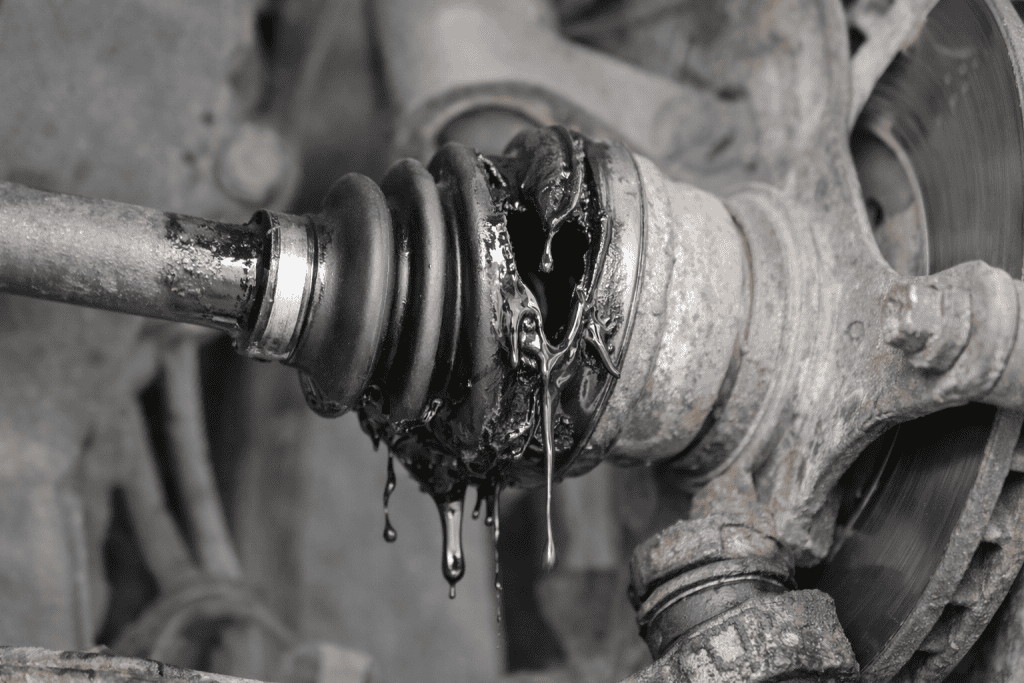
Although noise is the primary symptom, visual inspection can provide additional confirmation. Torn or leaking CV boots are a strong indicator of joint contamination and wear.
For instance, grease splattered on suspension parts or inside the wheel well often points directly to a failing CV joint. Therefore, combining sound diagnosis with a visual check improves accuracy.
Close-up photo of a torn CV boot leaking grease around the axle and wheel hub, showing a common visual sign of CV joint failure.
Why Early Detection Matters
Ignoring CV joint or axle noise can lead to complete joint failure. If a CV joint breaks, the vehicle may lose drive to one or more wheels, leaving it immobile.
Additionally, continued driving can damage nearby components such as wheel bearings, transmission seals, or differential mounts. As a result, repair costs rise significantly when early warning signs are overlooked. Understanding repair scope and expense is covered further in the CV Joint Replacement Cost Guide.
CV Joint Noise vs. Other Common Noises
Distinguishing CV joint noise from other vehicle sounds is essential:
Tire noise usually changes with road surface, not steering angle
Brake noise typically occurs during braking, not acceleration or turning
Wheel bearing noise often produces a steady hum that changes with speed
Therefore, clicking during turns remains one of the most reliable indicators of CV joint problems. However, because drivetrain issues can overlap with gear-related symptoms, it is also helpful to review Signs of Transmission Problems when diagnosing unexplained noises or vibration.
When to Address the Problem
If CV joint or axle noise is detected, inspection should be performed as soon as possible. In some cases, replacing a damaged boot early can extend joint life. However, once noise is present, full axle or CV joint replacement is often required.
Addressing the issue promptly helps maintain driveline reliability and prevents unexpected breakdowns.
This platform analyzes depreciation trends, resale value behavior, and long-term ownership costs, helping drivers understand how mileage, maintenance, and timing shape real financial outcomes.