The drivetrain is one of the most important yet least understood systems in a vehicle. It is responsible for transferring engine power to the wheels, allowing the car to move, accelerate, and respond smoothly to changing driving conditions. Therefore, understanding drivetrain basics is essential for recognizing early mechanical problems, avoiding costly repairs, and maintaining long-term vehicle reliability.
Although drivetrain components are built to handle significant stress, wear develops gradually over time. As a result, small issues often appear as subtle noises, vibrations, or performance changes before major failures occur.
What the Drivetrain Does
The drivetrain converts engine output into usable motion at the wheels. While the engine generates power, the drivetrain determines how that power is delivered, controlled, and distributed.
In simple terms, the drivetrain:
- Transfers torque from the engine to the wheels
- Adjusts power through gearing and speed changes
- Allows wheels to turn at different speeds when cornering
- Maintains traction and stability under load
Because each component depends on the others, a problem in one area can quickly affect the entire system.
Main Drivetrain Components Explained
Transmission
The transmission controls gear ratios, allowing the engine to operate efficiently at different speeds. It also enables smooth acceleration and proper torque delivery.
When transmission components wear, drivers may notice delayed shifting, slipping gears, or harsh engagement. Therefore, this behavior is often Signs of Transmission Problems one of the first indicators of drivetrain trouble.
Driveshaft or Drive Axles
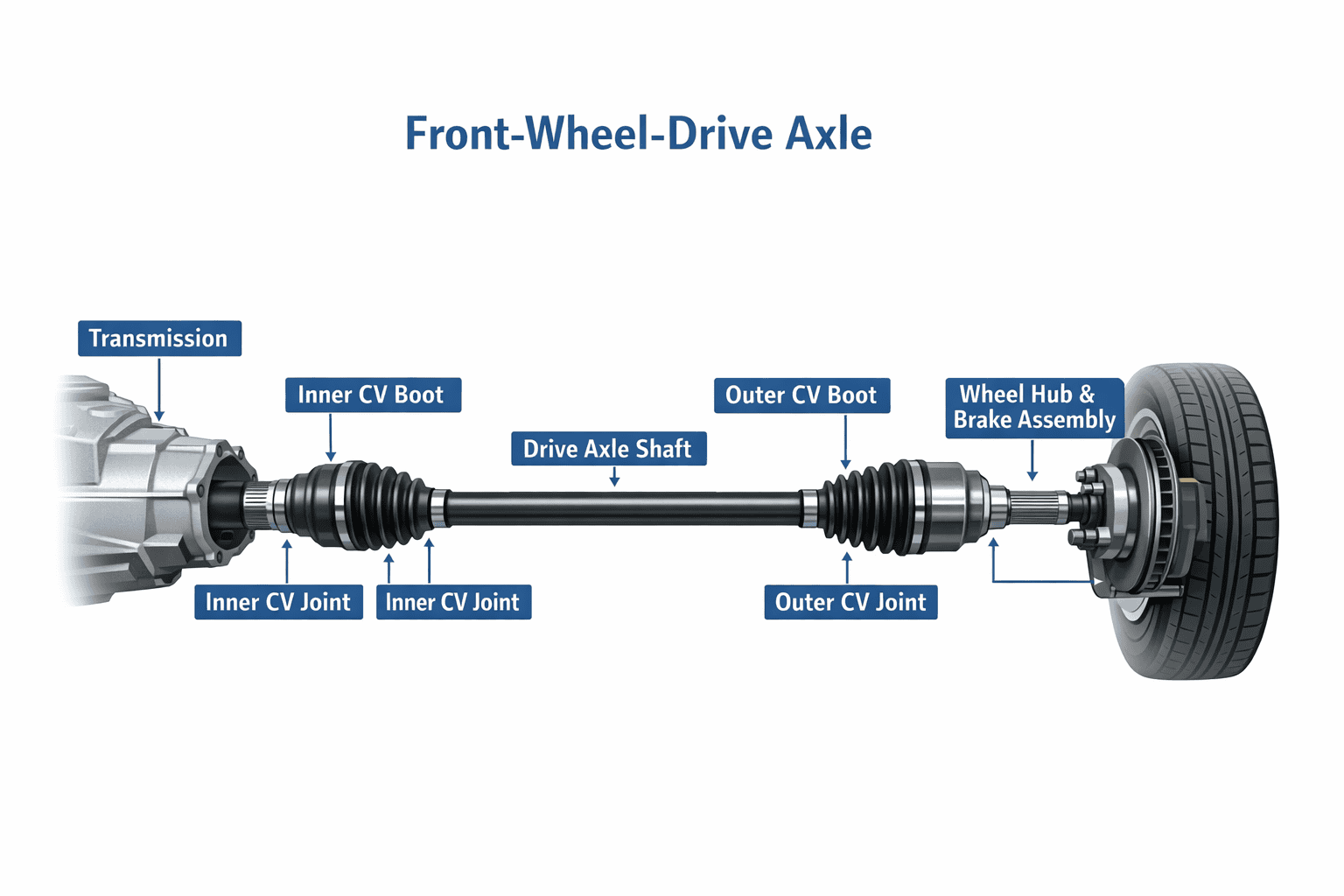
Depending on drivetrain layout, power is delivered through a driveshaft or individual drive axles. These components physically transmit torque from the transmission or differential to the wheels.
For example, front-wheel-drive vehicles use CV axles, while rear-wheel-drive vehicles rely on a long driveshaft connected to a rear differential. Any imbalance or wear here can cause vibration and noise.
CV Joints
Constant velocity (CV) joints allow axles to flex while delivering smooth power, even during steering and suspension movement. They are critical for front-wheel-drive and many all-wheel-drive systems.
However, when CV boots tear and lubrication escapes, joint wear accelerates rapidly. As a result, clicking noises during turns often develop. Understanding How to Recognize CV Joint or Axle Noise can save hundreds on repair cost
Differential
The differential allows wheels on the same axle to rotate at different speeds, especially during turns. Without it, tires would scrub and handling would suffer.
Meanwhile, differentials also manage torque distribution, particularly in limited-slip or electronically controlled systems.
Transfer Case (AWD / 4WD Only)
Vehicles with all-wheel drive or four-wheel drive use a transfer case to distribute power between the front and rear axles. This component plays a key role in traction under low-grip conditions.
Because it operates under load, transfer case fluid condition and internal wear are critical to drivetrain longevity.
Common Drivetrain Layouts
Front-Wheel Drive (FWD)
In front-wheel-drive vehicles, the engine, transmission, and drive axles are all located at the front. This layout is compact, efficient, and widely used.
However, CV joints and axles experience higher stress during turning and acceleration.
Rear-Wheel Drive (RWD)
Rear-wheel-drive systems separate steering and driving forces. Power flows from the engine through the transmission, driveshaft, and rear differential.
As a result, RWD vehicles often provide better balance but rely heavily on driveshaft and differential health.
All-Wheel Drive (AWD) and Four-Wheel Drive (4WD)
These systems distribute power to all wheels, improving traction and stability. However, they introduce additional drivetrain components, increasing maintenance complexity.
Therefore, early detection of noises or vibration is especially important in AWD and 4WD vehicles.
Early Warning Signs of Drivetrain Problems
Drivetrain issues rarely appear suddenly. Instead, they develop gradually with recognizable symptoms:
- Clicking or popping during turns
- Clunking when shifting or accelerating
- Vibration that increases with speed
- Grinding or whining noises
- Delayed or harsh gear engagement
For example, a clicking noise during low-speed turns often points to CV joint wear, while a steady hum may indicate bearing or differential issues.
Why Drivetrain Knowledge Matters
Understanding drivetrain fundamentals helps drivers make informed decisions. When symptoms are recognized early, repairs are usually simpler and less expensive.
Additionally, ignoring drivetrain warning signs can lead to secondary damage affecting the transmission, wheel bearings, or suspension. As a result, repair costs escalate quickly.
How Drivetrain Issues Connect to Other Systems
Drivetrain problems often overlap with:
- Transmission warning signs
- Suspension and steering issues
- Wheel bearing noise
- Engine performance symptoms
Therefore, drivetrain inspection is often part of diagnosing broader vehicle problems rather than an isolated system check.
Drivetrain Maintenance Basics
Although many drivetrain components are sealed, maintenance still plays a key role:
- Monitor fluid condition where applicable
- Inspect CV boots regularly
- Address abnormal noises immediately
- Avoid aggressive driving on damaged components
Meanwhile, routine inspections help prevent minor wear from turning into major failures.
Final Thoughts
The drivetrain is the mechanical backbone of any vehicle. While it operates mostly out of sight, its condition directly affects performance, safety, and reliability.
By understanding how drivetrain components work together and recognizing early warning signs, drivers can protect their vehicle from unexpected breakdowns and long-term damage.