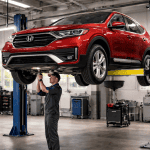
The steering wheel is the direct connection between driver input and vehicle response. Every turn, correction, and adjustment begins here. That motion travels through the steering column, into the rack-and-pinion system, and ultimately changes the direction of the front wheels.
Modern steering wheels are no longer just mechanical. Since the 1990s, manufacturers like Bosch, ZF, and TRW (now part of ZF Group) have integrated electronic systems into steering design. Airbags became standard in the early 1990s, while electronic power steering (EPS) expanded rapidly after 2010. Today, the steering wheel also controls driver assistance systems, infotainment, and safety features. Because of this evolution, the steering wheel now sits at the center of both mechanical control and electronic communication, making failures more complex than in older vehicles.
Steering Wheel Components Breakdown
A steering system is made up of multiple interconnected parts. Some are directly inside the wheel, while others operate along the steering column and drivetrain.
Steering System Components Overview
Component
Location
Function
Why It Matters
Steering Wheel
Driver interface
Transfers input to steering system
Primary control point
Airbag Module
Center of wheel
Deploys during collision
Critical safety system (mandated in U.S. since 1998)
Clock Spring
Behind wheel
Maintains electrical connection while turning
Powers airbag, horn, and controls
Steering Angle Sensor
Column/wheel
Tracks wheel position
Feeds ABS and stability systems
Steering Column
Between wheel and rack
Transfers rotational force
Core mechanical linkage
Intermediate Shaft
Mid connection
Links column to steering rack
Handles alignment and movement
U-Joints
Along shaft
Allow angled rotation
Prevent binding in steering motion
EPS Motor & Torque Sensor
Rack or column
Provides steering assist
Reduces driver effort and improves efficiency
As these components work together, wear in one area often creates symptoms elsewhere. For example, a failing clock spring may disable steering wheel controls, while a worn intermediate shaft can cause stiffness or vibration.
Common Steering Wheel Problems
Steering issues rarely appear all at once. Most develop gradually, often starting with minor electrical faults or subtle changes in steering feel.
Common symptoms include:
Steering wheel buttons not responding
Airbag warning light staying on
Horn not working
Steering wheel off-center
Clicking or rubbing noise when turning
Stiff or heavy steering
Loose steering feel
Vibration at highway speeds
Heated steering wheel failure
As these issues develop, they often begin affecting both comfort and safety. For example, vibration may not seem critical at first, but it often connects to braking or suspension wear. Understanding how suspension problems develop over time becomes important when diagnosing steering-related vibration, especially when components begin interacting under load. See https://flipcars.ca/car-suspension-how-it-works-problems-and-replacement/
What Causes Steering Wheel Failures
Steering problems typically originate from either electrical faults or mechanical wear.
The most common causes include:
Broken clock spring
Faulty steering angle sensor
Damaged column wiring
Worn U-joints in the intermediate shaft
EPS motor or torque sensor failure
Airbag module faults
Loose steering column mounting points
As these failures develop, they begin to affect system communication. Electronic components rely on CAN bus networks introduced widely in the early 2000s, allowing modules to communicate across the vehicle. When one sensor fails, it can trigger multiple warning systems, including traction control and stability control. In many cases, early symptoms are subtle. Electrical faults may appear intermittently before becoming permanent, while mechanical wear often starts as slight resistance or noise before progressing into noticeable steering instability.
Steering Repair and Replacement Costs
Steering system repairs vary depending on whether the issue is electrical, mechanical, or both.
Component
Typical Cost (USD)
Notes
Clock Spring
$150 – $450
Common failure affecting controls and airbag
Steering Angle Sensor
$200 – $600
Requires calibration after replacement
Steering Wheel
$300 – $1,200
Varies by material and electronics
Airbag Module
$400 – $1,000
Safety-critical component
Intermediate Shaft
$250 – $500
Affects steering feel and response
Steering Column
$600 – $1,500
Labor-intensive replacement
Costs can increase if multiple systems are affected. For a more accurate estimate based on your vehicle, using a repair cost estimator provides a clearer breakdown of real-world pricing: https://flipcars.ca/repair-cost-estimator/
When Steering Components Need Attention
Steering issues should be addressed as soon as symptoms appear, especially when safety systems are involved.
Service becomes necessary when:
The airbag warning light remains on
Steering feels loose or unstable
Electrical controls stop working
Noise develops while turning
Vibration increases with speed
The wheel no longer centers properly
Ignoring these signs can lead to further damage across connected systems, including suspension, braking, and drivetrain components. In some cases, continued driving can increase long-term repair costs or reduce overall vehicle reliability.
Extending Steering System Life
Steering components are built to last, but driving habits and maintenance play a major role in how long they remain reliable.
Practical steps include:
Avoid using the steering wheel as a support when entering or exiting the vehicle
Keep liquids away from steering wheel electronics
Avoid turning the wheel while the vehicle is stationary for long periods
Address vibrations early before they affect connected components
Follow a consistent maintenance schedule
Long-term reliability often depends on how the vehicle is used day to day. Driving habits such as aggressive turning, rough road exposure, and sudden inputs can accelerate wear across steering and suspension systems. Understanding how driving habits affect long-term vehicle reliability helps explain why some vehicles develop steering issues earlier than others: https://flipcars.ca/how-driving-habits-affect-long-term-vehicle-reliability/
Frequently Asked Questions
The position of the steering wheel is tied to which side of the road a country drives on. In countries like the United Kingdom, Japan, Australia, and India, vehicles drive on the left side of the road, so the steering wheel is placed on the right side of the vehicle.
This setup improves visibility and safety. With the driver positioned closer to the center of the road, it becomes easier to judge distance from oncoming traffic, overtake safely, and maintain proper lane positioning.
The origins go back centuries. In the 1700s, most people were right-handed and traveled on the left side of roads to keep their dominant hand free—especially when riding horses. This carried into early road systems. When automobiles became common in the early 1900s, countries largely kept their existing traffic patterns.
In contrast, the United States and much of Europe adopted right-side driving, influenced by wagon design and later standardized by manufacturers like Ford in the early 1900s. This led to left-side steering wheels, which remain the standard in those regions today.
Today, vehicle design simply follows national traffic laws. The steering wheel position is not about preference—it’s about alignment with road systems to ensure visibility, control, and safety.
The United States adopted right-side driving in the 1800s, influenced by wagon design where drivers sat on the left to control horses more effectively. When Henry Ford introduced the Model T in 1908, left-side steering became standardized, making it easier for drivers to see oncoming traffic and judge lane position.
Yes, in most regions it is legal, but it can be less practical. Visibility when passing or merging becomes more difficult, and some toll booths, drive-thrus, and parking setups are designed for left-hand drive vehicles.
Vibration is usually caused by imbalance or wear in rotating components. Common causes include:
Unbalanced tires
Warped brake rotors
Worn suspension parts
Misaligned wheels
When vibration appears during braking, it often points to rotor issues. When it occurs at highway speeds, it is more commonly related to tires or suspension. Understanding how suspension wear affects vehicle control can help diagnose the source more accurately: https://flipcars.ca/car-suspension-how-it-works-problems-and-replacement/
An off-center steering wheel is typically caused by wheel alignment issues or uneven suspension wear. Even if the vehicle drives straight, the steering angle may be slightly off due to improper alignment settings. Correcting alignment restores proper steering position and prevents uneven tire wear over time.
No. A loose steering wheel can indicate worn components in the steering column, intermediate shaft, or mounting points. This reduces steering precision and can become a serious safety issue if left unaddressed. The vehicle should be inspected as soon as possible to identify the source of the looseness.
Electric power steering (EPS) became widely adopted after 2010 because it improves fuel efficiency and allows better integration with driver assistance systems. Companies like Bosch and ZF helped develop EPS systems that adjust steering assist based on speed and driving conditions. Unlike older hydraulic systems, EPS only uses power when needed, reducing energy loss and improving overall efficiency.
Yes. Steering problems often overlap with suspension and braking systems. For example, worn suspension components can cause vibration, while alignment issues can affect both steering feel and tire wear.
This is why addressing issues early—and following a proper maintenance approach—helps prevent larger repair costs over time.
Final Thoughts on Steering System Function
The steering wheel is no longer just a control surface—it is a central hub connecting mechanical movement, electronic systems, and safety features. As vehicles have evolved, so has the complexity behind even the smallest steering input. Staying ahead of early warning signs, maintaining supporting components, and understanding how the system operates helps keep steering precise, predictable, and safe under all driving conditions.
This platform analyzes depreciation trends, resale value behavior, and long-term ownership costs, helping drivers understand how mileage, maintenance, and timing shape real financial outcomes.