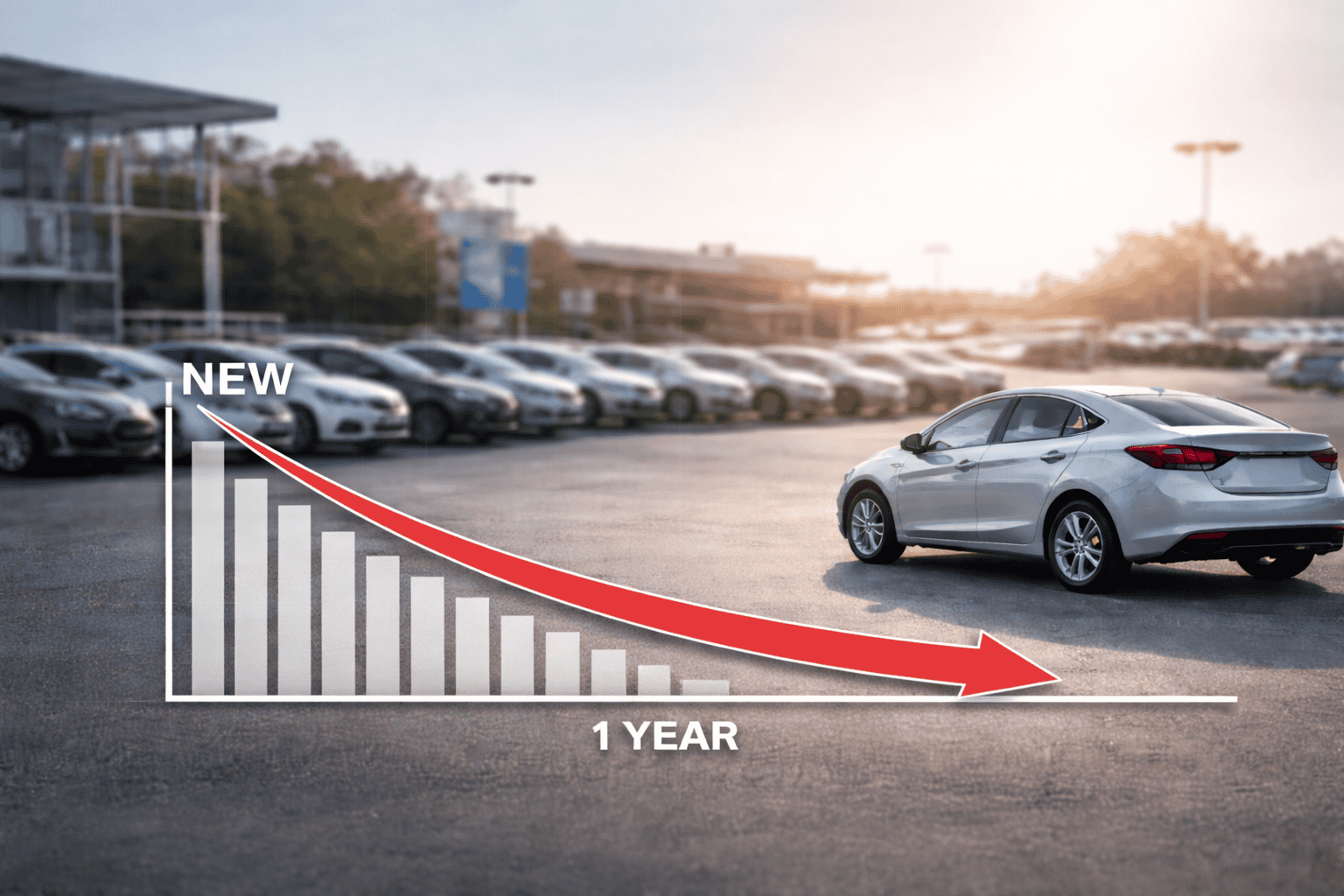
One of the biggest financial surprises in vehicle ownership is how quickly value drops after purchase. The moment a new vehicle is registered and driven, first year car depreciation begins immediately.
In practice, most vehicles lose between 15% and 25% of their value during the first year, although premium brands or high-demand models may retain slightly more. Industry resale data from Kelley Blue Book shows that most vehicles lose significant value during their first ownership year. That initial drop happens because the vehicle instantly transitions from “new inventory” to “used vehicle status,” even if it only has minimal mileage.
For many drivers, this becomes clear when they check trade-in offers within the first 12 months and discover the market price is far below what they paid. The reality is, the largest depreciation loss almost always occurs before the second registration renewal arrives.
What Causes Such a Large First-Year Value Drop
Several factors combine to accelerate car depreciation first year losses.
Market Reclassification
Once sold, the vehicle can no longer be marketed as brand new. That alone removes a significant portion of its retail pricing advantage.
Most drivers notice that identical models sitting on dealership lots still command higher prices simply because they have never been titled. That single administrative change can translate into thousands of dollars in value.
Warranty and Incentive Pricing
New vehicles often include promotional financing, rebates, or dealer incentives. However, those incentives do not transfer into resale value.
What matters most is that buyers shopping used vehicles compare market listings — not what the original owner paid after incentives. As a result, resale pricing resets to actual used-market demand.
Buyer Psychology
Used-car buyers expect a discount compared to new pricing. Even a nearly new vehicle must compete with older listings priced lower.
Sometimes the first sign of this reality appears when insurance valuation reports list the replacement value well below the purchase contract. It can feel abrupt. But it reflects standard market behavior.
Mileage and Condition Still Influence First-Year Loss
Although depreciation is unavoidable, ownership habits still affect vehicle resale value during that first year.
Higher mileage accelerates value loss because it signals increased wear and reduced remaining lifespan.
For example, a commuter vehicle that accumulates 25,000 miles in its first year will typically appraise far lower than a similar vehicle driven only 8,000 miles. That difference alone can add several percentage points to depreciation.
In practice, cosmetic condition also matters more than many owners expect. Minor dents, wheel scratches, or interior stains can compound the already steep new car value loss curve.
That’s when owners realize small cosmetic repairs often pay for themselves at trade-in time.
How Vehicle Type Changes First-Year Depreciation
Not all vehicles lose value equally in year one.
Generally:
- Luxury vehicles often depreciate faster due to higher initial pricing and expensive option packages
- Economy vehicles typically retain value better because of strong used-market demand
- Trucks and practical SUVs often hold value well if reliability ratings remain strong
The reality is that resale demand matters more than brand prestige. A dependable, high-demand model can outperform a premium vehicle simply because buyers trust its long-term ownership costs.
This is why researching long-term ownership expectations before purchase can reduce total depreciation exposure.
You can also learn more about long-term value trends in How Vehicle Depreciation Works and What Affects Resale Value.
Real Ownership Scenario: Why First-Year Loss Feels Bigger Than Expected
For many drivers, the financial impact becomes real during early trade-in discussions.
A buyer may purchase a vehicle for ,000, drive it for ten months, then receive dealer offers around ,000–,000. Nothing is mechanically wrong. Mileage may even be average.
But the vehicle has still crossed the threshold into used-car classification.
That’s when depreciation stops feeling theoretical and starts feeling very real.
Can You Reduce First-Year Depreciation?
While you cannot eliminate first year car depreciation, you can reduce how much value disappears.
Effective strategies include:
- Choosing models known for strong resale history
- Avoiding expensive cosmetic-only option packages
- Keeping mileage near national averages
- Maintaining full service documentation
- Protecting exterior and interior condition
In practice, owners who document maintenance and avoid cosmetic damage often recover noticeably higher resale offers even within the first ownership year.
Because of that, depreciation management starts the day the vehicle leaves the dealership — not when it’s time to sell.
The Consequences of Ignoring Early Depreciation
Ignoring early depreciation can affect several financial decisions.
Owners who roll negative equity into new loans may face higher monthly payments and longer payoff periods. Over time, repeated early trade-ins can compound ownership costs significantly.
What matters most is understanding that depreciation is not just an accounting number. It directly affects loan balance, insurance payouts, and future purchasing flexibility.
That’s why evaluating depreciation before buying — not after — protects long-term ownership finances.