Owning a Honda Civic is known for being affordable, but the real numbers depend on the model year, trim, engine, mileage, and how the car has been maintained. This guide breaks down every major cost category so visitors can understand what to expect, why costs vary, and how to choose the Civic that fits their budget long‑term.
1. Annual Ownership Cost Overview
Below is a realistic look at what most Civic owners spend each year. These figures blend insurance, maintenance, fuel, repairs, and depreciation.
Average Annual Cost to Own a Honda Civic
Cost Category
Typical Annual Cost
Notes
Insurance
$1,350–$1,850
Lower for LX/EX, higher for Si/Type R
Maintenance
$350–$550
Oil, filters, fluids, inspections
Repairs
$150–$350
Minor fixes; Civics rarely need major work
Fuel
$1,200–$1,600
Based on 30–36 MPG and average mileage
Depreciation
$1,000–$1,800
Depends heavily on model year
Total Estimated Annual Ownership Cost:$4,050–$6,150
5. Insurance Costs (Why It Varies & What To Do)
Insurance is one of the biggest ongoing expenses for any Honda Civic owner, and it can swing hundreds of dollars per year depending on the trim, engine, model year, and even how the car has been driven. This section breaks down why premiums change, what each trim typically costs, and how to choose the Civic that keeps your insurance bill under control.
Insurance companies look at dozens of factors, but these are the biggest drivers for Honda Civic premiums.
1. Engine Size & Performance Level
Higher‑output engines cost more to insure because they’re statistically involved in more claims.
2.0L LX/EX: lowest risk
1.5L Turbo EX/Touring: moderate risk
Si: performance‑tuned turbo
Type R: high‑performance 315‑hp engine
Impact: Performance trims can cost 40–70% more to insure than an LX.
2. Model Year & Repair Cost
Newer Civics have more technology, sensors, and expensive body panels.
A 2023 Civic bumper with sensors can cost $1,200–$1,800 to replace
A 2016 bumper may cost $450–$700
Impact: Newer models = higher premiums due to repair complexity.
3. Trim Value & Replacement Cost
Insurance is partly based on how much the car is worth.
LX has the lowest replacement cost
Touring, Si, and Type R have the highest
Impact: Higher trims can raise premiums by $200–$600 per year.
4. Driver Profile & Location
Your personal details matter:
Younger drivers pay more
Urban areas cost more than rural
Clean driving records lower premiums
Impact: A 22‑year‑old may pay 2× what a 40‑year‑old pays for the same Civic.
5. Modifications & Aftermarket Parts
Insurers charge more for:
Tunes
Exhaust upgrades
Lowering springs
Aftermarket wheels
Engine modifications
Impact: Modified Si/Type R models can trigger surcharges of 10–25%.
What To Do (How to Lower Your Civic Insurance Costs)
This is where visitors get clear, actionable steps.
1. Choose the Right Trim for Your Budget
Lowest insurance: LX or EX
Moderate: Sport
High: Si
Very high: Type R
If insurance cost matters, avoid performance trims.
2. Always Compare Quotes Using the VIN
Insurance estimates based on “year + trim” are often inaccurate. Using the exact VIN reveals:
Accident history
Theft risk
Safety features
Build options
This can change your premium by $150–$400.
3. Avoid Modified Cars
Modified Civics often trigger:
Higher premiums
Denied claims
Required specialty insurance
If you want predictable costs, stick to stock models.
4. Look for Civics With Advanced Safety Features
Cars with Honda Sensing often qualify for discounts:
Collision mitigation
Lane‑keeping assist
Adaptive cruise control
These features can reduce premiums by 5–10%.
5. Keep a Clean Driving Record
Even one minor ticket can raise your Civic’s insurance by:
$200–$500 per year for 3 years
Safe driving = lower long‑term ownership cost.
Bottom Line
Insurance costs for the Honda Civic vary widely depending on trim, performance level, model year, and driver profile. LX and EX trims offer the most affordable premiums, while Si and Type R models sit at the top due to their performance capabilities and higher repair costs. By choosing the right trim, avoiding modified cars, and comparing quotes using the VIN, buyers can keep their insurance expenses predictable and manageable.
3. Maintenance Costs (How Much, Why It’s Low, What To Do)
Honda Civic maintenance costs are one of the main reasons this car has such a strong reputation for affordable ownership. Most routine work is simple, parts are widely available, and major failures are rare when the car is serviced on time. This section walks through how much you can expect to spend, why the Civic is cheaper to maintain than many rivals, and what smart owners do to keep costs predictable over the long term.
Newer components, fewer repairs, mostly routine service
Over a 5‑year period, most Civic owners spend roughly $1,800–$2,500 on maintenance, which is often 15–30% lower than many compact competitors.
Maintenance cost stat bars vs typical compact rivals
The Civic usually sits at the lower end of the segment for long‑term maintenance spending, especially when serviced on schedule.
Why Honda Civic maintenance costs stay low
1. Simple, proven engines Non‑turbo 2.0L engines are straightforward and have been refined over many years. They rarely need major internal work if oil changes are done on time.
2. Long service intervals Oil changes are typically every 7,500–10,000 miles (or annually), and other fluids have long replacement windows. This reduces the number of shop visits per year.
3. Affordable parts and wide availability Brake pads, filters, belts, and suspension components are widely available from both Honda and aftermarket brands, keeping prices competitive.
4. Strong reliability record Because major failures are uncommon, most owners only pay for routine items—oil, filters, brakes, tires, and occasional wear parts.
Typical service items and cost ranges
Service Item
Approx. Cost (Per Visit)
Recommended Interval
Oil & filter change
$60–$120
7,500–10,000 miles
Engine air filter
$30–$60
15,000–30,000 miles
Cabin air filter
$40–$80
15,000–30,000 miles
Brake pads (axle)
$180–$300
40,000–60,000 miles
CVT fluid service
$180–$260
30,000–60,000 miles
Coolant service
$120–$200
60,000–100,000 miles
Spark plugs (turbo)
$180–$260
60,000–80,000 miles
Owners who follow these intervals usually avoid surprise repair bills and keep the car running smoothly well past 150,000–200,000 miles.
Turbo vs non‑turbo maintenance
Non‑turbo (2.0L):
Lower complexity
Fewer heat‑related concerns
Slightly cheaper long‑term
1.5L turbo:
Needs timely oil changes
Spark plugs and fluids are more sensitive to neglect
Still affordable if maintained properly
On average, turbo Civics may cost $50–$100 more per year in maintenance if you follow best practices, but they often repay that with better fuel economy.
What smart Civic owners do to keep maintenance costs low
1. Follow the maintenance minder, not guesswork Use the car’s built‑in maintenance minder or the official schedule. Skipping services might save money short‑term but often leads to higher costs later.
2. Use quality fluids and parts Stick with synthetic oil, proper CVT fluid, and reputable filters. Cheap fluids can shorten engine or transmission life and erase the Civic’s reliability advantage.
3. Fix small issues early Address minor noises, vibrations, or warning lights quickly. A small brake issue or fluid leak caught early might cost $150–$300 instead of $800+ if ignored.
4. Compare dealer vs independent shop pricing Dealers are convenient and know the car well, but a trusted independent shop can often perform routine services for 10–25% less while using quality parts.
5. Plan for wear items over time Budget for brakes, tires, and fluids over a 5‑year window instead of treating them as surprises. This makes Civic ownership feel predictable and stress‑free.
How to choose the right Civic if maintenance cost is a priority
Pick non‑turbo 2.0L LX or EX if you want the simplest, lowest‑maintenance setup.
Choose 2016+ models if you want newer components and fewer age‑related repairs.
Avoid neglected, high‑mileage cars with missing service records—even if the price looks attractive.
Look for documented oil changes, CVT fluid services, and brake work; a well‑maintained Civic will almost always cost less to own than a cheaper, poorly maintained one.
In short, the Honda Civic keeps maintenance costs low by combining reliable engineering, long service intervals, and affordable parts. With basic care and timely servicing, most owners enjoy years of trouble‑free driving without heavy repair bills.
4. Fuel Costs (MPG Breakdown & Savings)
Fuel costs are one of the biggest day‑to‑day expenses for any Honda Civic owner. While the Civic is already known for excellent efficiency, the actual fuel bill depends on the engine, trim, driving style, and even wheel size. This section breaks down how much you’ll realistically spend, why MPG varies, and what you can do to keep fuel costs as low as possible.
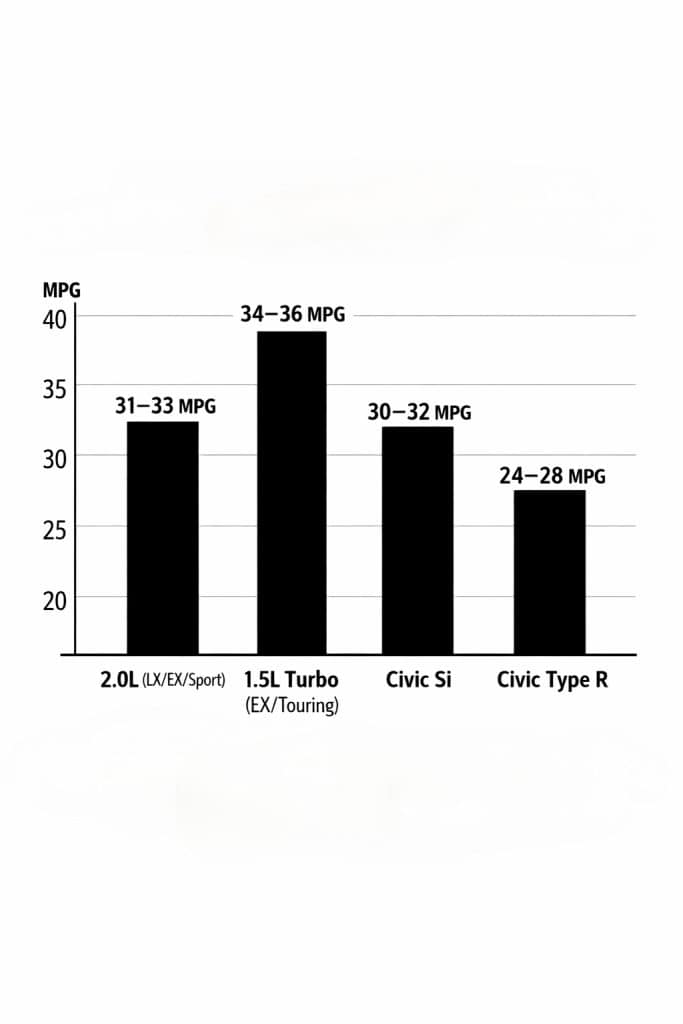
This bars graph show how each Civic engine performs in everyday driving, not just ideal test conditions.
The 1.5L turbo consistently delivers the strongest blend of power and efficiency, while the Type R trades MPG for performance.
Average Annual Fuel Cost
Assuming 12,000–15,000 miles per year and average U.S. fuel prices:
Engine / Trim
Combined MPG
Annual Fuel Cost
Notes
2.0L
31–33 MPG
$1,350–$1,550
Simple, predictable efficiency
1.5L Turbo
34–36 MPG
$1,200–$1,450
Best long‑term fuel savings
Si
30–32 MPG
$1,400–$1,650
Sporty driving lowers MPG
Type R
24–28 MPG
$1,750–$2,200
Performance tuning = higher fuel use
Choosing a 1.5L turbo EX over a 2.0L Sport can save $150–$250 per year in fuel alone.
Why Fuel Costs Change
Fuel economy in a Honda Civic isn’t determined by the engine alone. Real‑world conditions—how you drive, where you live, the wheels you choose, and how well the car is maintained—can shift your annual fuel bill by hundreds of dollars. This section breaks down every factor that affects MPG, explains why it matters, and shows what you can do to control your fuel spending.
Engine Efficiency Breakdown
2.0L (LX/EX/Sport):31–33 MPG combined — efficient, predictable, and consistent in everyday driving.
1.5L Turbo (EX/Touring):34–36 MPG combined — the strongest fuel economy in the Civic lineup.
Civic Si:30–32 MPG combined — sport‑tuned engine with moderate efficiency.
Civic Type R:24–28 MPG combined — performance‑focused setup with the lowest MPG.
Fuel Cost Comparison: Civic vs Competitors
Model
Combined MPG
Annual Fuel Cost
Ranking
Honda Civic (1.5T)
34–36
$1,200–$1,450
★ Best
Toyota Corolla
32–34
$1,300–$1,550
Very Good
Mazda3
28–31
$1,450–$1,750
Mid
Hyundai Elantra
31–33
$1,350–$1,600
Good
Nissan Sentra
29–33
$1,400–$1,650
Mid
The Civic consistently ranks among the top two for fuel savings in the compact segment.
What To Do (How to Reduce Fuel Costs)
Here’s where visitors get clear, actionable steps to keep fuel spending low.
1. Choose the Right Trim for Efficiency
Best MPG: EX or Touring with the 1.5L turbo
Good MPG: 2.0L LX or EX
Avoid for MPG: Si and Type R
If fuel savings matter, the 1.5L turbo is the clear winner.
2. Keep Tires Properly Inflated
Underinflated tires can drop MPG by up to 10%.
Check pressure monthly
Adjust for seasonal temperature swings
3. Use Quality Fuel & Oil
Use Top Tier gasoline for cleaner combustion
Use synthetic oil for smoother engine operation
This helps maintain peak efficiency.
4. Avoid Excessive Idling & Short Trips
Cold engines burn more fuel. Combine errands and avoid warming the car longer than necessary.
5. Drive Smoothly
Gradual acceleration
Maintain steady speeds
Use cruise control on the highway
Smooth driving can improve MPG by 10–15%.
6. Keep Up With Maintenance
Replace air filters on schedule
Keep spark plugs fresh
Ensure CVT fluid is changed on time
A well‑maintained Civic can save $100–$200 per year in fuel.
Bottom Line
Fuel costs for the Honda Civic stay low because of its efficient engines, lightweight design, and strong real‑world MPG. The 1.5L turbo offers the best long‑term savings, while the 2.0L remains a dependable, economical choice. With smart driving habits and basic maintenance, Civic owners can keep fuel expenses predictable and significantly lower than most compact competitors.
Fuel Cost Comparison: Civic vs Competitors
Model
Combined MPG
Annual Fuel Cost
Ranking
Honda Civic (1.5T)
34–36
$1,200–$1,450
★ Best
Toyota Corolla
32–34
$1,300–$1,550
Very Good
Mazda3
28–31
$1,450–$1,750
Mid
Hyundai Elantra
31–33
$1,350–$1,600
Good
Nissan Sentra
29–33
$1,400–$1,650
Mid
The Civic consistently ranks among the top two for fuel savings in the compact segment.
What To Do: How to Reduce Fuel Costs in a Honda Civic
Fuel savings don’t happen by accident. The Civic is already efficient, but the way you choose your trim, maintain the car, and drive day‑to‑day can push your MPG higher or lower by a noticeable margin. Below is a complete, detailed breakdown of how to get the best mileage, why each step matters, and what you should do next.
1. Choose the Right Trim for Efficiency
Your trim and engine choice set the foundation for your long‑term fuel spending.
Best MPG Options
EX or Touring with the 1.5L turbo These trims consistently return 34–36 MPG combined, making them the most fuel‑efficient Civics available. The turbo engine cruises at lower RPM on the highway, which cuts fuel use without sacrificing power.
1. Choose the Right Trim for Efficiency
Your trim and engine choice set the foundation for your long‑term fuel spending.
Best MPG Options
EX or Touring with the 1.5L turbo These trims consistently return 34–36 MPG combined, making them the most fuel‑efficient Civics available. The turbo engine cruises at lower RPM on the highway, which cuts fuel use without sacrificing power.
Why This Matters
Choosing the right engine can change your annual fuel bill by $150–$700, depending on mileage and driving habits.
What To Do
Pick 1.5L turbo EX/Touring if fuel savings are your priority.
Choose 2.0L LX/EX if you want predictable MPG with lower maintenance.
Skip Si/Type R if efficiency is more important than performance.
2. Keep Tires Properly Inflated
Tire pressure has a bigger impact on MPG than most drivers realize.
Why It Matters
Underinflated tires increase rolling resistance, forcing the engine to work harder.
A drop of just 5–7 PSI can reduce MPG by up to 10%.
Seasonal temperature swings can lower tire pressure by 1 PSI for every 10°F.
What To Do
Check tire pressure once a month.
Adjust pressure when temperatures change significantly.
Follow the PSI listed on the driver‑side door jamb, not the tire sidewall.
Savings
Proper tire pressure alone can save $50–$120 per year in fuel.
3. Use Quality Fuel & Oil
The Civic doesn’t need premium gas, but it does benefit from cleaner fuel and proper oil.
Why It Matters
Top Tier gasoline contains detergents that keep injectors clean, improving combustion.
Synthetic oil reduces friction, helping the engine run more efficiently.
A clean, well‑lubricated engine burns less fuel and maintains peak performance.
What To Do
Fill up with Top Tier fuel whenever possible.
Stick to synthetic oil and follow Honda’s recommended viscosity.
Avoid bargain‑bin gas stations with inconsistent fuel quality.
Savings
Using quality fuel and oil can preserve 1–2 MPG, saving $50–$100 per year.
4. Avoid Excessive Idling & Short Trips
Short trips and long warm‑ups are MPG killers.
Why It Matters
Cold engines run richer (more fuel, less efficiency).
Idling gets 0 MPG and wastes fuel quickly.
Multiple short trips prevent the engine from reaching optimal temperature.
What To Do
Combine errands into one longer trip.
Avoid warming the car for more than 30–60 seconds unless temperatures are extreme.
Turn off the engine if you’ll be parked for more than a minute.
Savings
Reducing idle time can save $75–$150 per year.
5. Drive Smoothly
Your driving style has one of the biggest impacts on real‑world MPG.
Why It Matters
Hard acceleration dumps extra fuel into the engine.
Constant speed changes waste energy.
Smooth driving keeps the engine in its most efficient range.
Real‑World Impact
Gradual acceleration: +2 to +4 MPG
Aggressive driving: –3 to –6 MPG
Cruise control on the highway: +1 to +2 MPG
What To Do
Accelerate gently.
Maintain steady speeds whenever possible.
Use cruise control on open highways.
Anticipate traffic instead of reacting late.
Savings
Smooth driving can improve MPG by 10–15%, saving $150–$250 per year.
6. Keep Up With Maintenance
A well‑maintained Civic burns less fuel and stays efficient for years.
Why It Matters
Small maintenance items have a big effect on MPG:
Dirty air filter: –1 to –2 MPG
Old spark plugs: –1 to –3 MPG
Low‑quality oil: –1 MPG
Neglected CVT fluid: reduced efficiency and long‑term wear
What To Do
Replace air filters on schedule.
Keep spark plugs fresh, especially on turbo models.
Change CVT fluid at recommended intervals.
Follow Honda’s maintenance minder for accurate timing.
Savings
Proper maintenance can save $100–$200 per year in fuel and prevent bigger repair bills later.
Bottom Line
Fuel savings come from a combination of smart trim selection, proper tire care, quality fuel, smooth driving, and routine maintenance. The Honda Civic already starts with strong MPG, but drivers who follow these steps consistently see lower annual fuel costs, better long‑term performance, and a more enjoyable ownership experience.
5. Repair Costs (What Breaks & How Often)
Honda Civics rarely need major repairs, but here’s what owners typically encounter.
Common Repair Costs
Repair Type
Typical Cost
Frequency
Brake pads
$180–$300
Every 40k–60k miles
Wheel bearings
$250–$400
Occasional
AC repairs
$200–$600
Some 10th gens
Turbo components
$300–$900
Rare but possible
Suspension bushings
$150–$350
Normal wear
Why Repairs Stay Low
Strong engine reliability
Simple suspension design
Affordable aftermarket parts
What To Do
Avoid high‑mileage turbo models with poor service history
Inspect AC performance on 2016–2019 models
Check for uneven tire wear (alignment issues)
7. Total Cost of Ownership by Trim
5‑Year Ownership Cost Estimate
Trim
5‑Year Cost
Notes
LX
$20,500–$24,000
Lowest insurance + simple engine
Sport
$22,000–$26,000
Higher insurance
EX
$22,500–$27,500
Best MPG + strong resale
Touring
$25,000–$30,000
Higher tech = higher repair cost
Si
$27,000–$33,000
Performance parts + insurance
Type R
$34,000–$42,000
Premium maintenance + highest insurance
Choosing the Right Honda Civic Based on Your Budget and Priorities
Picking the right Civic comes down to understanding what you value most: the lowest possible ownership cost, long‑term value, performance, or the newest tech. Each recommendation below explains why that specific range of years or trim makes sense, what advantages it brings, and who it’s best suited for.
If you want the lowest overall cost
Choose: 2016–2018 LX or EX
These years strike the best balance between price, reliability, and everyday running costs. They avoid the premium pricing of newer models while still offering modern safety features and strong fuel economy.
Why these years make sense
Lower insurance premiums: The 2.0L engine and modest trim levels keep insurance rates down compared to turbo models or performance trims.
Affordable maintenance: Parts are inexpensive, and the 2.0L engine is simple, proven, and easy to service.
Strong reliability record: These years have matured past early‑production issues and are known for long‑term durability.
Who this fits
Drivers who want dependable transportation with predictable costs and no surprises. Ideal for commuters, students, and anyone watching their budget.
If you want the best long‑term value
Choose: 2021–2023 EX
These model years sit at the sweet spot where modern features, excellent MPG, and high resale value all intersect. They’re new enough to avoid age‑related repairs but not so new that you pay a premium.
Why these years stand out
Excellent fuel economy: The 1.5L turbo delivers some of the best MPG in the segment.
High resale strength: These years consistently retain more of their value, often 4–6% higher than base trims.
Modern features: Updated infotainment, improved safety tech, and a more refined cabin make them feel newer than they are.
Who this fits
Buyers who want a Civic that will hold its value, stay reliable for years, and deliver strong MPG without stepping into luxury pricing.
If you want performance without breaking the bank
Choose: Civic Si
The Si is the perfect middle ground for drivers who want excitement without the cost of a Type R. It delivers real performance while staying affordable to insure and maintain.
Why the Si is the smart performance pick
Far cheaper than a Type R: Purchase price, insurance, and maintenance all stay within reach.
Strong resale value: Clean, unmodified Si models hold their value extremely well thanks to enthusiast demand.
Lower insurance than Type R: Still sporty, but not in the same high‑risk category as the Type R.
Who this fits
Drivers who want a fun, engaging Civic with real performance credentials but don’t want the financial commitment of a Type R.
If you want the newest tech and lowest early‑ownership costs
Choose: 2022–2024 (11th‑generation)
The 11th‑gen Civic brought a major leap in interior quality, refinement, and technology. These years offer the most modern experience and the lowest likelihood of repairs.
Why the 11th‑gen is the tech leader
Better materials: Higher‑quality cabin materials, improved ergonomics, and a cleaner design.
Improved reliability: Honda refined the powertrains and electronics, reducing early‑ownership issues.
Lower repair risk: Newer cars naturally require fewer repairs, especially in the first 3–5 years.
Who this fits
Buyers who want a Civic that feels brand‑new, offers the latest tech, and minimizes repair concerns for the foreseeable future.
This platform analyzes depreciation trends, resale value behavior, and long-term ownership costs, helping drivers understand how mileage, maintenance, and timing shape real financial outcomes.