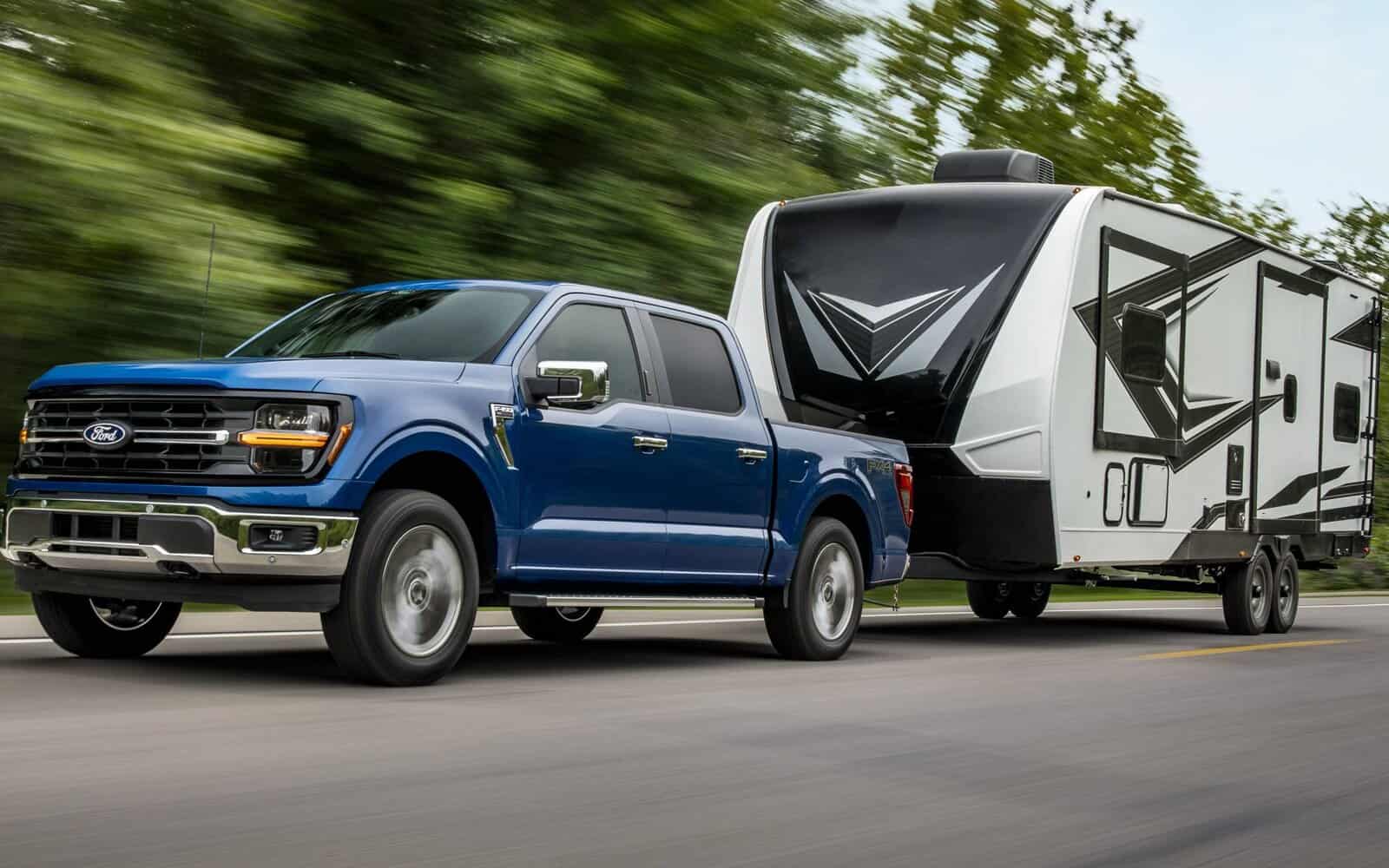
If you’re among the drivers who need to tow a trailer, camper, or personal watercraft, you already know that a vehicle’s towing capacity is a crucial factor when purchasing a vehicle—whether new or used. Yet, many people don’t fully understand what this number actually represents or how to apply it correctly in real-world conditions.
A vehicle’s manufacturer-rated towing capacity represents the maximum weight it can safely tow. This includes both the weight of the trailer and its cargo. That limit is determined by multiple factors, including the engine, transmission, braking system, chassis, differential, and—most importantly—the type of hitch installed.
Why Towing Capacity Doesn’t Tell the Whole Story
A common mistake is assuming that a vehicle rated to tow 5,000 lb can safely tow that amount at all times. In reality, this figure reflects a theoretical maximum under ideal conditions. In practical use, it’s recommended to leave a 10% to 15% safety margin below the rated limit to protect mechanical components and maintain trailer stability.
Real-world example: If your pickup is rated to tow 5,000 lb, it’s generally safer to limit towing to around 4,500 lb, especially if the vehicle is also carrying passengers or cargo.
How to Calculate a Vehicle’s Real-World Towing Capacity
To determine true towing capacity, three key values must be considered:
Term
Meaning
Where to Find It
GVWR (Gross Vehicle Weight Rating)
Maximum weight the vehicle can carry (passengers + cargo)
Driver-side door label
GCWR (Gross Combined Weight Rating)
Maximum allowed weight of vehicle + trailer + cargo
Owner’s manual
Curb Weight
Vehicle weight without passengers or cargo
Manufacturer specifications
Simplified formula: Towing Capacity = GCWR − Actual Vehicle Weight
For example, if the GCWR is 10,000 lb and your loaded vehicle weighs 5,800 lb (including passengers and cargo), your real towing capacity is 4,200 lb, not the advertised 5,000 lb.
The Importance of Proper Towing Equipment
Even the most capable SUV or truck cannot perform safely without the correct hitch. Trailer hitches are classified from Class I to Class V, each designed to handle specific loads.
Hitch Class
Max Load (lb)
Typical Vehicle
Class I
Up to 2,000 lb
Compact car
Class II
Up to 3,500 lb
Subcompact SUV
Class III
Up to 5,000 lb
Mid-size SUV
Class IV
Up to 10,000 lb
Full-size pickup
Class V
Over 10,000 lb
Heavy-duty vehicle
Always check the label on the hitch itself. It lists both the maximum trailer weight and the tongue weight (usually 10–15% of total trailer weight). Ignoring these limits can damage suspension components, brakes, or compromise safety during emergency maneuvers.
Towing Capacity vs. Payload: Finding the Right Balance
Trailer weight isn’t the only factor—payload inside the towing vehicle directly affects towing capacity. A vehicle carrying passengers, luggage, and accessories can tow less than an empty one. Every additional pound inside the vehicle reduces the amount you can safely tow.
That’s why manufacturers specify a Gross Combined Weight Rating (GCWR). Exceeding this limit can result in unstable braking and longer stopping distances, which becomes especially dangerous on hills or wet roads.
Can You Tow with an Electric Vehicle?
As electric vehicles become more popular, a common question arises: can an EV tow effectively? The answer depends on the model.
Some electric SUVs—such as the Hyundai IONIQ 5 or Tesla Model Y—offer towing capacities between 2,000 and 3,500 lb, while electric trucks like the Ford F-150 Lightning or Chevrolet Silverado EV can exceed 10,000 lb.
However, towing with an EV significantly impacts driving range—often reducing it by 30% to 50% when hauling heavy loads. Careful planning is essential before towing a trailer or camper with an electric vehicle.
Tips for Safe Towing
Distribute 60% of the trailer’s weight toward the front to reduce sway
Use a weight distribution hitch for heavier trailers
Check tire pressure on both the vehicle and trailer
Install electric trailer brakes if the trailer exceeds 3,000 lb (1,350 kg)
Monitor transmission temperature during long uphill drives
Final Thoughts
Relying solely on a manufacturer’s advertised towing capacity is a common mistake. Safe towing requires understanding GCWR, hitch class, weight distribution, and the vehicle’s actual load.
When in doubt, always consult the owner’s manual or a certified dealership to confirm the correct specifications for your exact vehicle configuration.
[…] Gladiator, or Wagoneer, expect fuel economy in the 19–22 MPG range. These vehicles offer high towing capacity, off-road muscle, and V6 or V8 powertrains, but fuel efficiency isn’t their strong […]
This platform analyzes depreciation trends, resale value behavior, and long-term ownership costs, helping drivers understand how mileage, maintenance, and timing shape real financial outcomes.